
Feature Article
Choking Risks Associated with Konjac Jelly: What You Need to Know
While any food can pose a choking hazard, certain firm, small items that do not dissolve easily, such as mini-cup konjac jellies, may present a higher risk if not consumed properly, especially for young children and the elderly. This article aims to outline measures to mitigate the choking risks associated with konjac jelly.
Choking Risks of Mini-cup Konjac Jellies
Konjac, also known as conjac, konnyaku, yam flour, glucomannan, or by its INS number Note 1 425 (E425), is a common ingredient in jelly products. The Codex Alimentarius Commission (Codex) considers konjac a safe additive, permitting its use as a thickener, emulsifier, stabiliser and more in a range of foods. However, unlike gelatin-based jelly, konjac jelly is much firmer and less likely to dissolve in the mouth.
Some konjac jellies are packed in semi-rigid, dome-shaped mini-cups designed for easy consumption, allowing consumers to either suck the jelly out in one bite or squeeze the cup to project it into their mouth. Mini-cups that are 45 mm or less in height or width allow the konjac jelly to be eaten whole or sucked from the containers. With its smooth, slippery surfaces, konjac jelly can slide to the back of the mouth and may become lodged in the throat, obstructing the airway like a plug and increasing the risk of choking.
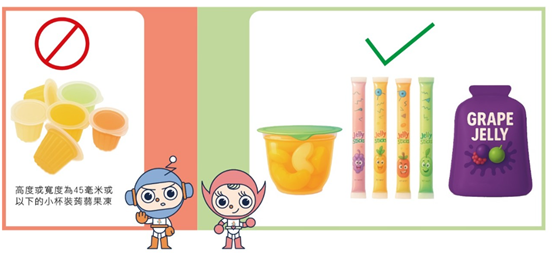
Figure: Konjac jellies come in various sizes and shapes
Mitigating Choking Risks of Konjac Jelly
Proposal on Regulation of Konjac-containing Jelly Confectionery
To address this concern, the Centre for Food Safety (CFS) has proposed regulating the sale of jelly confectionery products containing konjac through legislative measures. The proposed amendments stipulate that if a mini-cup jelly confectionery product has a height or width of 45 mm or less, it shall not contain konjac. Furthermore, all prepackaged konjac-containing jelly confectionery products are required to be labelled with a warning statement on the prevention of a choking hazard in both Chinese and English:
注意:勿一口吞食,長者及兒童需在監護下食用。
Caution: Do not swallow whole. Elderly and children must consume under supervision.
The regulatory proposal is available on the CFS's designated webpage Note 2. Members of the public and the trade are welcome to offer their views on or before 8 June 2025.
Health Education
The CFS has been spreading health education messages on the prevention of food choking through its website, seminars, social media and posters. In addition, the CFS, in collaboration with the Education Bureau, has issued a letter to schools, advising them to stop providing or selling mini-cup konjac jellies in places such as tuck shops and school canteens to avoid potential choking risks before the implementation of the proposed regulatory measures.
Moreover, the CFS has produced an educational video and a video advertisement to highlight common choking hazards and promote safe eating habits. The CFS will continue to organise school talks and disseminate information online to raise public concern about choking prevention and strengthen education among ethnic minorities.
Choking risks can be reduced by observing the following safe eating habits:
- Avoid eating while talking, laughing or running.
- Do not suck mini-cup konjac jelly directly from the packaging.
- Cut konjac jelly into smaller pieces and eat them with a spoon.
- Take small bites, chew well, and swallow between bites.
Key Points to Note
- Konjac jellies are safe for consumption; however, improper consumption of mini-cup konjac jellies may pose a choking risk.
- The Government is proceeding with the proposed legislative amendments to prohibit the sale of mini-cup konjac-containing jelly products with a height or width of 45 mm or less.
- Practicing good eating habitsNote 3 can reduce the risk of choking.
Advice to the Public
- Do not let young children or the elderly eat mini-cup konjac jellies.
- Supervise young children and the elderly while they are eating non-mini-cup konjac jellies to ensure safe consumption.
- Follow the consumption advice on the packaging of konjac jellies.
Note 1: Codex develops the International Numbering System for Food Additives (INS), which serves as an international system for identifying food additives. For more information about INS, please visit the following webpage:
https://www.cfs.gov.hk/english/whatsnew/whatsnew_fstr/whatsnew_fstr_13_ins.html

Note 2: The CFS's dedicated webpage on “Public Consultation on Proposal on Regulation of Konjac-containing Jelly Confectionery”:
https://www.cfs.gov.hk/english/whatsnew/whatsnew_fstr/whatsnew_fstr_regulation_of_konjac-containing_jelly_confectionery.html

Note 3: Information about developing good eating habits from a young age is available at:
https://www.cfs.gov.hk/english/school/EatSafeAtSchool_poster_choking_hazard_e.pdf

Mascot ON in Lesson
1. School Meals and Food Safety
Recently, there was a suspected case of food poisoning related to the consumption of beef lasagna provided by a school canteen. The kitchen of the school canteen concerned was required to suspend its operation for thorough cleaning and disinfection. Investigations revealed that prolonged storage of a large quantities of prepared meals and the poor hygiene conditions had raised food safety concerns.
When preparing food in large quantities, extra caution should be exercised as it is difficult to monitor and ensure all parts of the food are thoroughly cooked Note 1 and cooled Note 2 to a proper holding temperature. Storing cooked food at an improper holding temperature can result in spore germination of spore-forming bacteria such as Clostridium perfringens and Bacillus cereus. Improper food storage can also lead to bacterial proliferation.
To minimise the risk of food poisoning, school canteens and the trade should ensure there are adequate facilities, including cooking appliances and refrigerators, for food preparation, storage, cooling and distribution. Food handlers should maintain good personal hygiene and establish effective cleaning procedures for kitchens. Member of the public should consume meals served as soon as possible.
Note 1 Further information on cooking and reheating food is available at:
https://www.cfs.gov.hk/english/trade_zone/safe_kitchen/Cooking_and_reheating.html

Note 2 To learn more about cooling food, please visit the following webpage or scan the relevant QR code.
https://www.cfs.gov.hk/english/trade_zone/safe_kitchen/cooling.html

2. Salmonella and Tiramisu
Two suspected food poisoning cases related to the consumption of tiramisu were reported earlier on. The suspected causative agent was Salmonella. The CFS has instructed the premises concerned to suspend the sale of the implicated food products and carry out disinfection.
Investigation findings revealed that the incidents were very likely attributable to inadequate cooking and improper holding temperature of the food. Tiramisu is typically made without thorough heating to kill pathogens. Although pasteurised egg yolk solution was used in the preparation of the implicated cakes, it was mixed with unpasteurised raw egg white, which might have caused contamination. Bacterial proliferation might be the result of improper storage of the tiramisu.
Cooking food thoroughly can eliminate Salmonella and other pathogens. To reduce food safety risks, using pasteurised egg products instead of raw eggs for making raw or lightly cooked dishes is a good option. Pasteurised Note 1 eggs should not be mixed with raw eggs in making raw or lightly cooked dishes to prevent cross-contamination, and pasteurised eggs should be properly stored at or below 4℃ in refrigerators.
Note 1 For more information about pasteurisation, please visit the following webpage or scan the relevant QR code.
https://www.cfs.gov.hk/english/multimedia/multimedia_pub/multimedia_pub_fsf_174_02.html

Dining Out
“Poon Choi”: A heavyweight Cooking Battle
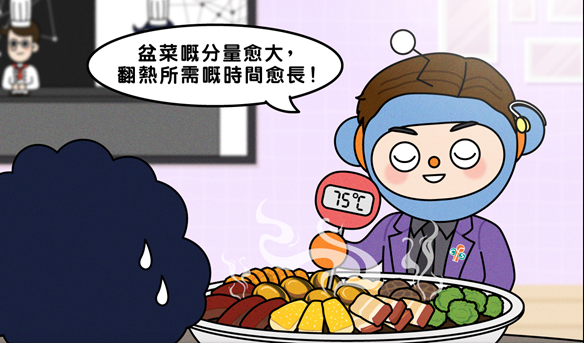
With so many choices of “poon choi” out there, what exactly makes one up to standard?
From my years of experience in savouring countless delicacies, food temperature is definitely one of the key criteria in my rating. Prepared dishes like “poon choi” must be thoroughly reheated before consumption to ensure the core temperature reaches 75℃ or above.
What's more, the larger the portion of the “poon choi”, the longer it takes to cook or reheat. And you can only reheat it once!
Tips from the Food Safety Judge:
Order your “poon choi” from reputable licensed food suppliers.
Maintain good personal and food hygiene to prevent cross-contamination when making your own “poon choi”.
For more food safety tips regarding autumn and winter delicacies, please visit:
https://www.cfs.gov.hk/english/multimedia/multimedia_pub/multimedia_pub_fsf_198_02.html

Healthy Eating Basics and Smart Food Choices
Healthy Eating Basics
1. The Truth about White Chocolate
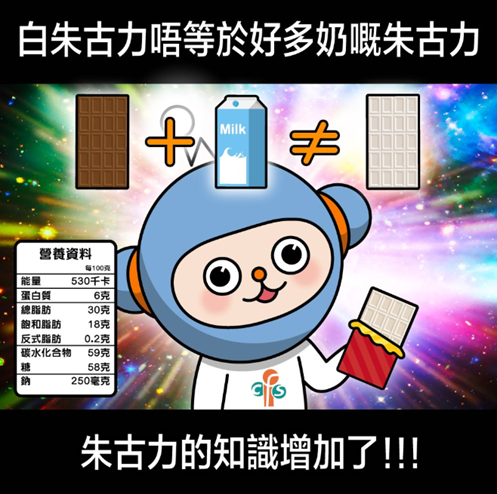
I Mascot ON used to believe what people said — that white chocolate is made by adding tons of milk to chocolate to lighten the colour. It turns out that it's not the case and I've been fooled for so long without realising it!
In fact, chocolate is made from cocoa butter, cocoa powder and cocoa paste, while white chocolate is mostly cocoa butter, a natural type of edible fat and oil. That's actually what gives white chocolate that milky colour, not milk. Chocolate, whether white or regular, is usually high in fat and sugar. Overdo it, and you’ll pile on the pounds and wreck your teeth.
Be a smarter consumer, before buying pre-packaged food, read the nutrition labels carefully, compare the calorie, fat and sugar content of different products and opt for the ones with lower content. Also, eat in moderation!
Information on nutrition labels is available at:
https://www.cfs.gov.hk/english/consumer_zone/safefood_all/food_nutrition_labelling.html

Smart Food Choices
Delicate Gourd Cups
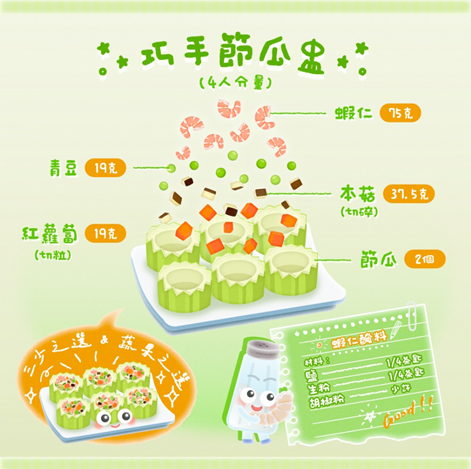
Low in energy and fat but high in dietary fibre, hairy gourds are ideal for satiety and weight control. Half a bowl of cooked hairy gourd is equivalent to one serving of vegetables, which helps achieve the health goal of three servings of vegetables per day. Here is the recipe of Delicate Gourd Cups, a nutritious dish that can be prepared with simple steps.
| Ingredients (Serve 4) | |
| Hairy gourd | 2 |
| Shrimp | 75g (about 2 taels) |
| Beech mushroom, shredded | 37.5g (about 1 tael) |
| Green pea | 19g (about 1/2 tael) |
| Carrot, diced | 19g (about 1/2 tael) |
| Seasonings for shrimps: | |
| Salt | 1/4 teaspoon |
| Cornstarch | 1/4 teaspoon |
| Pepper powder | Some |
Steps:
- Peel the gourds. Halve from the centre and remove the core. Carve patterns around the edge and set aside.
- Drain the shrimps. Dice, marinate in the seasonings for 15 minutes. Set aside.
- Blanch the beech mushrooms, green peas and carrot. Rinse in cold water, drain, let stand.
- Steam the gourds in a deep plate for 10 minutes, and then stuff them with the shrimps, beech mushrooms, green peas and carrot. Add some water and steam everything together until well done. Serve directly with the plate.
For more information, please scan the relevant QR code:

News on CFS
1. The 89th Meeting of the Trade Consultation Forum\
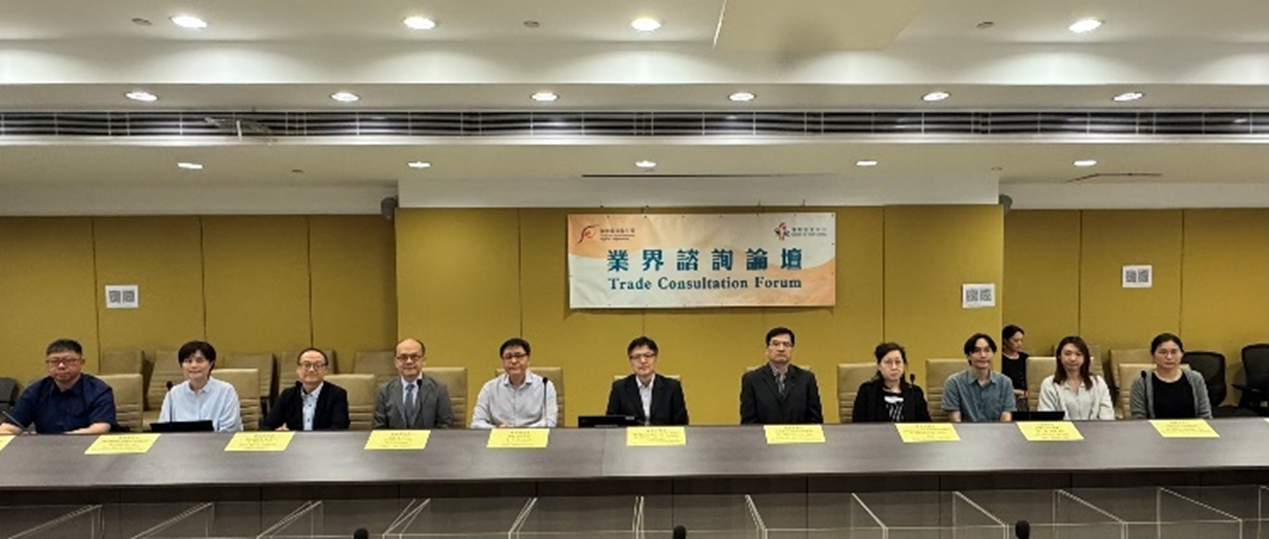
The 89th meeting of the Trade Consultation Forum was held on 12 June 2025. The CFS and the trade exchanged their views on topics including “Food Safety Guidelines for Food Businesses on Pre-cut Fruits and Fresh Fruit and Vegetable Juices”, “Safe Handling of Rice and Noodles to Prevent Food Poisoning, Including Bongkrekic Acid Poisoning”, “Proposal on Regulation of Konjac-containing Jelly Confectionery (Update)”, “Salt / Sugar” Label Scheme for Prepackaged Food Products, “Risk Assessment Study on T-2 toxins, HT-2 toxins and 4,15-diacetoxyscirpenol in Food”, and The Arrangement of “Access Procedure” for Hong Kong-Manufactured Meat and Dairy Products Importing to the Mainland. For details of the event, please visit the following webpage or scan the relevant QR code:
https://www.cfs.gov.hk/english/committee/Notes_and_Presentation_Materials_TCF89_20250612.html
2. Food Safety Day 2025
Keep Cooked and Raw Food Apart, Prevent Cross-contamination from the Start!
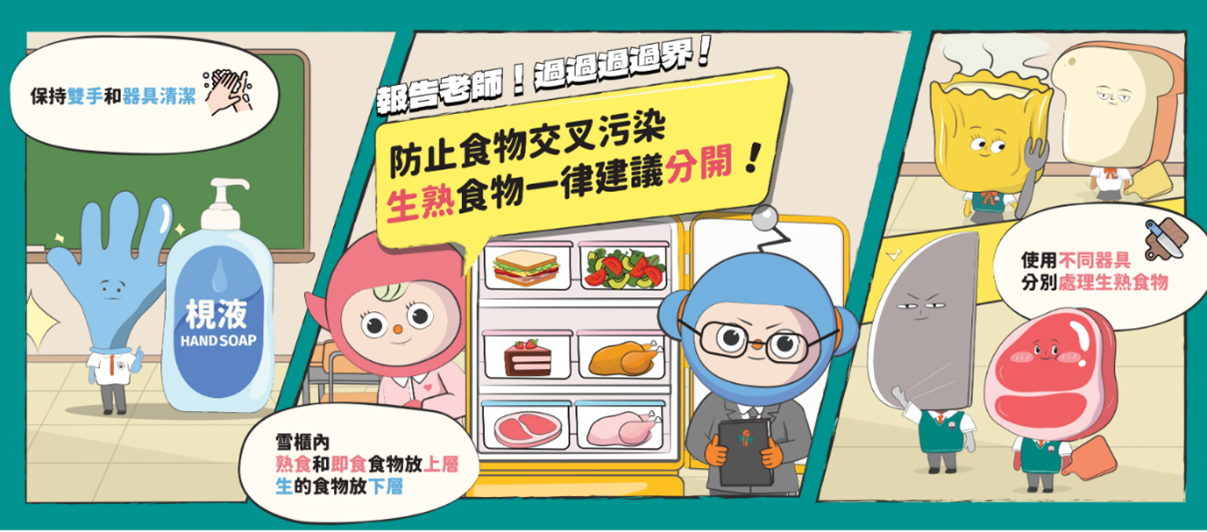
To support the United Nations’ World Food Safety Day on 7 June, the CFS took the opportunity to promote the importance of food safety to the food trade and the public in order to raise their awareness of the “Five Keys to Food Safety” as the best measures in preventing foodborne diseases. This year’s campaign highlights the “Separate” key, which emphasises the importance of preventing cross-contamination at all stages of food preparation in safeguarding food safety. By adopting good hygiene practices and following proper ways of food handling, such as storing and handling raw and cooked foods separately, using dedicated utensils and storage containers and maintaining good personal and environmental hygiene, food handlers can significantly reduce the risk of foodborne diseases.
For details of the campaign, please click the following link or scan the relevant QR code:
https://www.cfs.gov.hk/english/whatsnew/whatsnew_act/Food_Safety_Day_2025.htm
3. CFS's Online Talk on the Food Safety of Street Food
While street food is popular among local residents and tourists, its food safety and hygiene standards are of public concern. To facilitate the trade's implementation of food safety measures to ensure that food production and supply comply with hygiene standards, the CFS has complied “Street Food Stalls – Food Safety Guidelines for Food Businesses”. The guidelines, applicable to both permanent food stalls and temporary stalls operating at food fairs, festivals, night markets, etc., aim to increase the trade’s food safety awareness and practical skills. Furthermore, to enhance street food vendors’ understanding of food safety, the CFS specially held an online talk titled “Food Safety of Street Food” on 18 June to explain to the trade the fundamental food safety principles and practical guidelines for preparing street food, helping them implement food safety measures effectively in their daily operations to provide safe and hygienic food to consumers.
-
“Street Food Stalls – Food Safety Guidelines for Food Businesses”:

4. Media Briefing on Regulation of Konjac-containing Jelly Confectionery
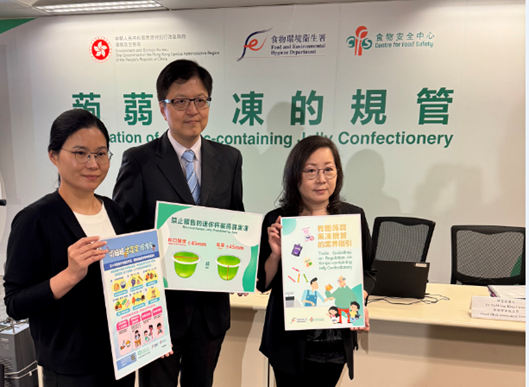
The Food and Drugs (Composition and Labelling) (Amendment) Regulation 2025 (Amendment Regulation) was gazetted on 18 July 2025 to strengthen the regulation of prepackaged konjac-containing jelly confectionery.
Under the new requirements, mini-cup konjac-containing jelly confectionery with a height or width not exceeding 45 millimetres is prohibited for sale in the market. In addition, other konjac jelly products must be labelled with choking warning statements on their packaging to remind consumers to exercise caution while eating.
The Amendment Regulation was tabled at the Legislative Council on 23 July 2025 for negative vetting. The new requirements for prepackaged mini-cup konjac-containing jelly confectionery will take effect on 1 April 2026, i.e. around six months after the completion of negative vetting of the Amendment Regulation.
The CFS will continue to enhance health education on choking prevention, including issuing letters to schools, organising seminars, and sharing information on social media. The CFS will also arrange technical meetings with the trade and issue user guidelines to facilitate the trade’s understanding of and compliance with the new requirements.
For more details on this topic, please visit the CFS's designated webpage or scan the relevant QR code.
https://www.cfs.gov.hk/english/whatsnew/whatsnew_fstr/whatsnew_fstr_regulation_of_konjac-containing_jelly_confectionery.html
Ask Mascot ON
1. Consuming Food Past the Expiry Date – Is It Safe?
Many people have misconceptions about “use by” and “best before” dates that appear on different types of prepackaged food products.
Expiry dates, which are indicated on food labels, can be categorised into two types: “use by” and “best before.” A “use by” date is related to food safety. Highly perishable foods, such as dairy products and salads, should not be consumed after the “use by” date as the food may have deteriorated, posing health risks. On the other hand, a “best before” date is about food quality instead of safety. Normally, the food should be safe to eat after this date, but its flavour and texture might not be as good as before. Nonetheless, consumers should not eat spoiled foods.
Consumers are reminded to check expiry dates when purchasing food and understand the differences between the two. Store food under recommended conditions and do not purchase or consume it if the packaging is damaged, even if it has not passed its expiry date on the label. Expiry dates apply only to unopened products, as their durability may change once they are opened.
2. Beware of Mad Honey Poisoning
Recently, several cases of mad honey poisoning involving the consumption of honey brought from overseas were reported locally and all affected persons required treatment in hospitals. Upon testing, grayanotoxin was detected in some honey remnants.
Mad honey poisoning is caused by the ingestion of honey containing grayanotoxins. Rhododendrons and other plants in the Ericaceae family are the source of grayanotoxins. Grayanotoxins are neurotoxins which can affect nerves and muscles. Symptoms of mad honey poisoning include vomiting, diarrhoea and dizziness. In severe cases, hypotension, bradycardia or shock may occur. Honey containing grayanotoxin may cause a burning sensation in the throat when consumed.
To reduce the risk of mad honey poisoning, the public and the trade should purchase honey from a reliable source or apiary. Pay special attention when bringing or importing honey from places, including India, Nepal and the Black Sea region of Türkiye, where honey-related grayanotoxin poisoning cases have been reported. Discard honey with a bitter or astringent taste. The CFS has enhanced public education on mad honey poisoning through various channels, including social media and its website.
Food Safety Quiz
- Which of the following statements regarding the proper handling of food to reduce cross-contamination is incorrect
- Use separate worktops to handle raw and cooked foods.
- Store food in covered containers or wrap it with cling film before putting it into the refrigerator.
- Store raw and cooked foods in the upper and lower compartments of the refrigerator respectively.
- Wash hands thoroughly with water and liquid soup before and after preparing food and after touching unclean objects.
- Which of the following descriptions of food label dates is correct?
- A “best before” date is about food safety instead of quality.
- The “use by” date only affects the taste of the food and is not a safety concern.
- Expiry dates apply only to unopened products.
- Highly perishable foods can be consumed after the “use by” date.
- Which of the following types of foods does NOT pose a high choking risk to children?
- Foods that do not dissolve easily (e.g. mini-cup konjac jellies)
- Small hard foods (e.g. nuts, hard candy)
- Soft and easy-to-chew banana
- Compressible foods (e.g. marshmallows)
Diary of Mascot ON
Beware of Choking Hazards of Snacks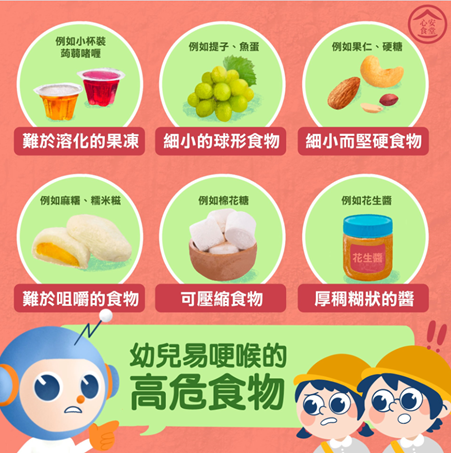
It is common for kindergarten or primary school pupils to consume or share various types of snacks during tea break or recess. Children have small air and food passages, and young children's food-biting or chewing skills are still under development. If they are careless or get distracted by play while eating tough and chewy foods, the foods may get stuck in the throat, potentially causing suffocation.
Mascot ON: Extra caution should be taken when eating the following foods with a high choking risk!
Jellies that do not dissolve easily (e.g. mini-cup konjac jellies)
Small hard foods (e.g. nuts, hard candy)
Small round foods (e.g. grapes, fish balls)
Hard-to-chew foods (e.g. mochi, glutinous rice cakes)
Compressible foods (e.g. marshmallows)
Thick pastes (e.g. peanut butter).
Dear kids, when you are eating, remember to sit upright and chew slowly; do not walk or even run or chase one another; and never suck mini-cup konjac jelly directly from the packaging, in order to prevent suffocation from choking.