



Food Safety Focus (242nd Issue, September 2026) – Article 2
Beyond the Label: Why Preservatives and Antioxidants Matter More Than You Think
Reported by Ms. Sosanna WONG, Scientific Officer,
Risk Assessment Section, Centre for Food Safety
Large-scale food processing requires the use of food additives to ensure the food safety and quality of processed food products throughout their entire journey from production to consumption. Preservatives and antioxidants are food additives commonly used to prolong the shelf life of food products.
The use of preservatives and antioxidants in food is governed by the Preservatives in Food Regulation (Cap. 132BD). The objective of the Preservatives in Food (Amendment) Regulation 2024 (the Amendment Regulation) is to keep local food safety standards on par with international standards, thereby enhancing consumer protection and facilitating the food trade.
This article discusses the functions of these additives in foods and the rationale behind the Amendment Regulation.
Understanding Preservatives and Antioxidants
Preservatives (e.g. sorbic acid and benzoic acid) delay spoilage caused by microorganisms like bacteria, moulds and yeasts.
By prolonging the shelf-life, preservatives ensure that food can be safely enjoyed at home.
Antioxidants (e.g. ascorbic acid and tocopherols) protect food from oxidation, preventing fats and oils in food from turning rancid and preserving flavour.
What is the Amendment Regulation About?
To keep local food safety standards on par with international standards, thereby enhancing consumer protection and facilitating the food trade , our food safety legislations are periodically reviewed and updated. The Amendment Regulation has kept the standards of the Codex Alimentarius Commission (Codex) as the backbone, supplemented with those adopted by the Chinese Mainland and other major food trading partners of Hong Kong.
Some major amendments include:
Permitted list: The total number of permitted preservatives and antioxidants has been increased from 32 to 58. The Amendment Regulation strengthens the regulatory control by bringing more of these additives under strict supervision, clearly defining permitted types and levels.
Maximum permitted levels (MPLs): The MPLs of permitted preservatives and antioxidants in specified food categories have been updated/stipulated, increasing the number of "additive-food" pairs from around 900 to around 2000.
Facts vs Myths
Let's address common misconceptions surrounding preservatives and antioxidants:
Myth 1: "Preservatives and antioxidants are unsafe"
Fact: Like other food additives, preservatives and antioxidants have undergone rigorous safety evaluation before permitted for food use. International and national food safety authorities, such as the Joint FAO/WHO Expert Committee on Food Additives (JECFA), evaluate the safety of these additives based on scientific reviews of all available toxicological and related data.
Myth 2: "Food free of preservatives and antioxidants is always safer"
Fact: Preservatives and antioxidants are important tools in today’s large-scale food processing and global food supply chain, where foods may travel long distances from factory to table. Without them, foods may spoil or turn rancid much faster. Properly regulated and used, these additives ensure food remains safe and stable throughout its journey.
Myth 3: "The use of preservatives and antioxidants is excessive"
Fact: Establishing MPLs for individual preservatives and antioxidants in specified food categories ensures that the total intake from all uses does not exceed the Acceptable Daily Intake (ADI), that is the amount of a food additive that can be ingested daily over a lifetime without appreciable health risk.
Myth 4: "Manufacturers can add as much preservatives as they want"
Fact: While the standards of preservatives and antioxidants are updated, the principles of using these additives remain unchanged. That is, the use of food additives is justified only when such use has an advantage, serving one or more technological functions in the food and does not compromise health of consumers.
What Does This Mean for You?
The trade is advised to make full use of the remaining window of the transitional period ending on 29 December 2026 and ensure their products comply with the Amendment Regulation. On the other hand, the public is advised to read the food label to make an informed choice, and maintain a balanced and varied diet.
For details of the Amendment Regulation, please visit the website of the Centre for Food Safety (CFS) which contains User Guidelines and Frequently Asked Questions to facilitate the trade's compliance.
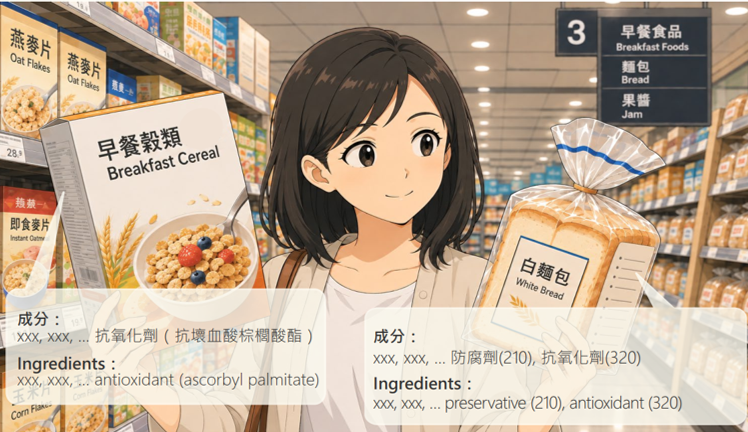 Figure 2: The ingredient list of prepackaged foods contains information on preservatives or antioxidants, if added