


Food Safety Focus (239th Issue, June 2026) – Article 1
Parasites in Marine Fish
Reported by Dr. Ken CHONG, Scientific Officer,
Risk Assessment Section, Centre for Food Safety
Background
Recently, a local short video showing a live thread-like parasite wiggling out of a piece of raw fish sashimi was widely circulated on social media, drawing much public attention. This underscores again the inherent microbiological risks associated with consuming raw fish. In fact, marine fish may contain parasites that are present in their growing environments.
Parasites in Marine Fish
Similar to bacteria, parasites are a natural part of the environment, and some of them are pathogenic to humans. Among these, roundworms of the family Anisakidae and tapeworms of the family Diphyllobothriidae are acquired by marine fish when they feed on infected crustaceans, which serve as intermediate hosts in the parasites' life cycles.
Two roundworm species, namely Anisakis simplex and Phocanema decipiens (formerly Pseudoterranova decipiens), are most commonly associated with human illness resulting from raw seafood consumption. The third-stage (L3) larvae of these species typically lodge within the tissues of the mesenteries and skeletal muscle of marine fish and squid. They are most common in predatory species of fish such as herring, cod, mackerel and sculpin. When humans eat infected fish harbouring live L3 larvae, the parasites will attempt to penetrate the gastric or intestinal lining, causing acute gastrointestinal symptoms, usually within hours of ingestion. Most infections are self-limiting as the larvae cannot survive long-term inside human, but the associated tissue damage can cause longer-lasting symptoms.
Regarding the family Diphyllobothriidae, the infective larval stage found in fish is known as a plerocercoid, which can mature into an adult tapeworm inside the human gut. Members of this family can be found in both freshwater and marine fishes, including perch, pike and salmon. Infected people may experience vomiting, abdominal discomfort, cramps, diarrhoea and shed ribbon-like proglottids in their faeces. Furthermore, these parasites can cause chronic infection where the worm can exceed 10 metres in length, eventually depriving the host of Vitamin B12 absorption.
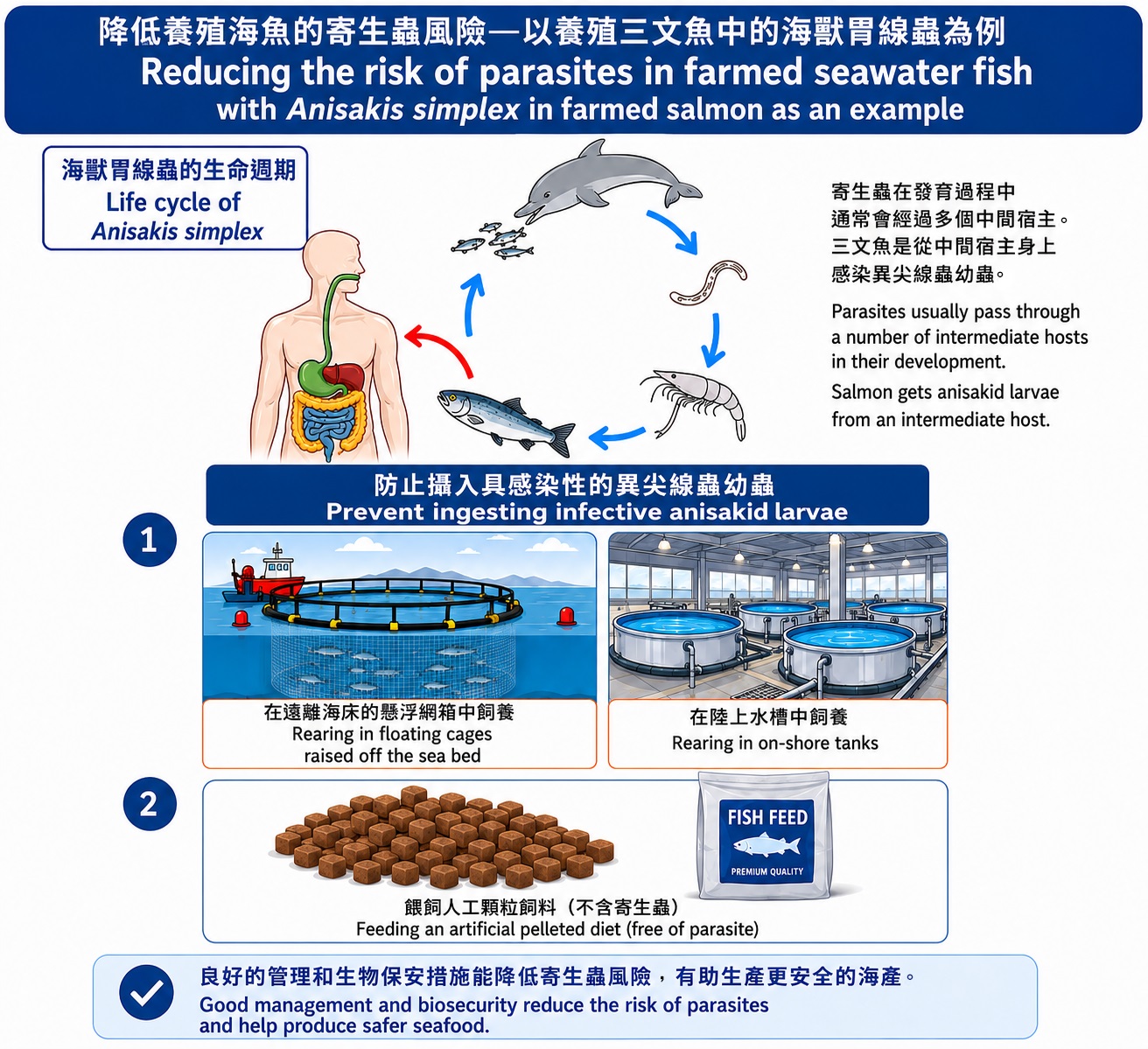 Figure: Reducing the risk of parasites in marine fish - Anisakis simplex in farmed salmon
Parasite-free Marine Fish Sashimi?
While a risk of parasitic contamination exists in marine fish sashimi, it remains a highly popular culinary choice. In practice, this biological hazard can be effectively managed through proper freezing treatments; a lower core temperature combined with a longer duration significantly minimises parasite survival rates. Common parasites found in marine fish sashimi and other undercooked fishery products (e.g. cold-smoked fish and gravlax) can be inactivated by freezing the core of the fish to -20°C for more than 24 hours. However, more stringent parameters, such as -20°C for seven days or at -35°C for 24 hours, are required for killing flukes.
Beyond freezing, robust parasite control programmes at the primary production level can substantially mitigate the risks. Utilising parasite-free artificial feed and maintaining controlled aquaculture environments are critical interventions (see Figure). Closed aquaculture systems effectively sever the transmission cycle of parasites that naturally occur in wild populations. For food premises serving marine fish sashimi, verifying documentation on relevant risk reduction measures for parasites helps to ensure food safety.
Although some consumers prefer marine fish sashimi made from wild-caught fish due to its specific texture and flavour, wild catches present a significantly higher likelihood of parasite infestation because their open habitats cannot be controlled. Consequently, a validated freezing treatment remains a mandatory safeguard for any wild-caught fish intended for raw consumption. That said, consumers should note that there are inherent risks of consuming raw fish. Despite measures to reduce the risk of parasites, bacteria and viruses that cannot be seen by the naked eyes may still be present.
Key Points to Note:
- Parasites naturally occur in marine fish, which typically contracts them by consuming infected crustaceans within the food chain.
- Freezing can reliably kill parasites in fish, though different combinations of temperature and holding time must be applied depending on the specific parasite being targeted.
- Freezing is an essential safeguard for wild-caught fish consumed raw in terms of parasitic risk, whereas comprehensive parasite control programmes (incorporating controlled feeds and closed environments) can successfully eliminate these risks in cultured fish.
Advice to the Public
- Patronise reliable licensed food premises/holders of restricted food permits with endorsement for the sale of sashimi when buying this high-risk food.
- Susceptible populations, including the elderly, young children, pregnant women and people with weakened immune systems are advised not to consume raw fish.
Advice to the Trade
- Obtain an official health certificate issued by the relevant authority of the exporting country and acceptable to the Director of Food and Environmental Hygiene, certifying that such food materials are suitable for consumption in the uncooked state, or obtain food materials supplied by a source approved by the Food and Environmental Hygiene Department (FEHD).
- Obtain a relevant licence/permit from the FEHD for the manufacturing and/or sale of sushi and sashimi.