



Food Safety Focus (235th Issue, Feb 2026) – Article 2
Does What We Eat Really Matter?
Reported by Ms. Jacqueline FUNG, Scientific Officer,
Risk Assessment Section, Centre of Food Safety
Have you ever thought about whether what we eat really matters? From the food safety perspective, it is about risk assessment. Food consumption data, i.e. types and amounts of food that people eat, collected through food consumption surveys (FCS), is essential in food safety assessments. By analysing food consumption data with the levels of chemical substances in food, the Centre for Food Safety (CFS) quantifies the population's dietary exposure to specific chemicals to assess the potential food safety risk to the population.
How to Collect Food Consumption Information?
Food consumption information can be collected in different ways, ranging from using food balance sheets to obtain an overview of food availability to collecting food consumption information of individuals to assess contaminant exposure or nutrient intake. To collect comprehensive food consumption data in Hong Kong, the CFS adopted two individual dietary assessment methods - 24-Hour Dietary Recall (24HDR) and Food Frequency Questionnaire (FFQ).
24-Hour Dietary Recall
24HDR is a widely used method for collecting dietary data in the Chinese Mainland, the USA, the UK and Australia. During a 24HDR, which is a structured interview lasting about 30-45 minutes, a trained interviewer assists a respondent to recall information on all food and beverages consumed on the previous day. Dietary information to be collected extends beyond the food names and the amounts consumed. Probing questions covering food type (e.g. full-cream vs low-fat milk, brand name), preparation methods (e.g. deep-fried, air-fried), additions (e.g. dipping sauces, sugars added at the table) and commonly forgotten food items (e.g. snacks consumed between meals) are used to elicit detailed information on food consumed. Considering day-to-day variations in food intake and to obtain a more representative food consumption estimate, 24HDR is often administered on two or more non-consecutive days.
Food Frequency Questionnaire
Despite its strengths, 24HDR may not adequately capture infrequently consumed food items (e.g. mooncakes) or foods with specific interest (e.g. swordfish, due to concerns about potential presence of metallic contaminant). To obtain a comprehensive picture of dietary intake, food frequency questionnaire (FFQ) is often used in conjunction with 24HDR. In FFQ, respondents report the frequency and portion size of consumption of a predefined list of foods. Surveys using 24HDR together with FFQ provide complementary information that enhances the robustness of estimates of a usual diet.
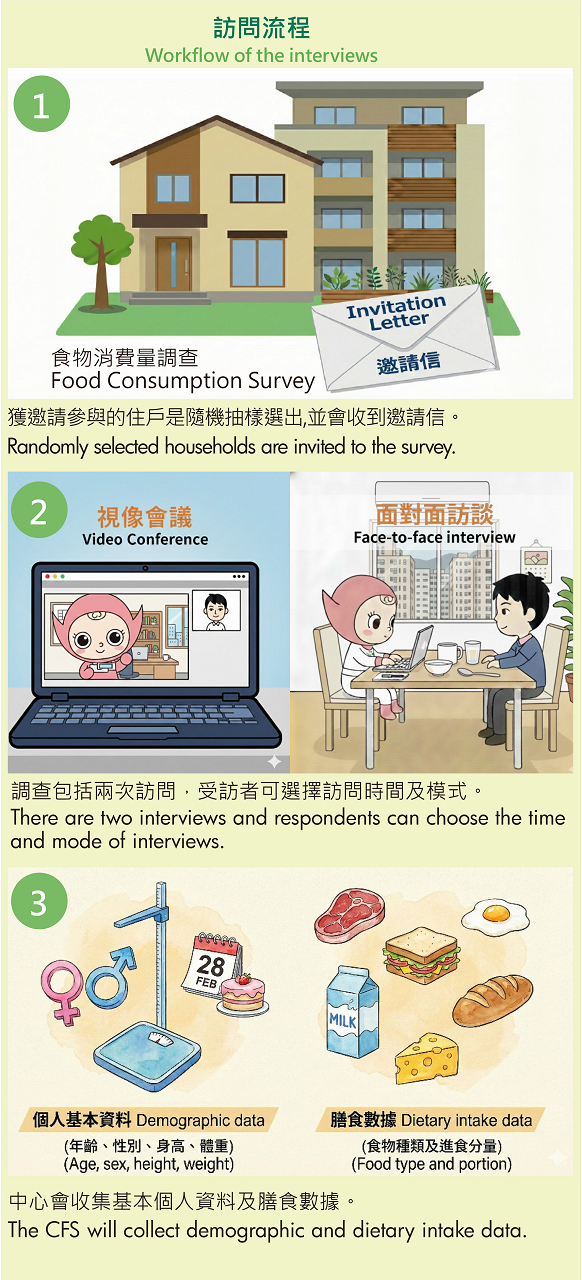
Figure: Workflow of the interviews of food consumption surveys and data collected
Food Consumption Surveys in Hong Kong
The CFS conducted the First Hong Kong Population-based Food Consumption Survey (1st HKFCS) in 2005 to 2007 covering individuals aged 20 to 84, which was Hong Kong's largest and most comprehensive FCS at the time. Due to changes in dietary habits and different dietary patterns among population subgroups, the CFS conducted the Second Hong Kong Population-based Food Consumption Survey (2nd HKFCS) in 2018-2020 on respondents aged 18 and above, followed by the Food Consumption Survey in the Younger Population (FCSYP) in 2021 to 2022 focusing on dietary intake of respondents aged 6 to 17.
Reports of these surveys are available on the CFS website, and summary results are available on DATA.GOV.HK for academic and public use. The findings of these surveys have been widely applied in food safety risk assessments conducted by the CFS, including the Total Diet Study. Food safety risk assessment results provide a scientific basis for the CFS to craft risk communication messages and to devise and implement suitable risk management. measures, which in turn help to safeguard public health in Hong Kong.
With changes in people's eating habits and the availability of new foods, the CFS is planning the next food consumption survey to ensure that food consumption information remains reliable and up-to-date to support day-to-day risk assessment work.
Use of Food Consumption Data for Food Safety Risk Assessment WorkThe CFS applies FCS findings in its food safety risk assessment work. Take the presence of metallic contaminants in food as an example. These are natural substances ubiquitous in the environment, which can be taken up by plants, animals and aquatic life that we consume, and are unavoidably present in our food. Long term excessive exposure to these metallic contaminants may affect our health. Since the presence of these contaminants is almost unavoidable, how can we figure out if the levels cause adverse effects? Risk assessors compare the exposure of these metallic contaminants a person would get from foods, based on the levels detected and the consumption amount of various foods from FCS data, and then compare the exposure calculated with the health-based guidance values (HBGVs) of these contaminants to evaluate the actual impact on health, as detailed in a previous article. |