


Food Safety Focus (244th Issue, November 2026) – Article 2
Full Compliance with the Amended Preservatives in Food Regulation (Cap. 132BD) starting from 30 December 2026
Reported by Ms. Joan YAU, Scientific Officer,
Risk Assessment Section, Centre for Food Safety
The amended Preservatives in Food Regulation (Cap. 132BD) must be fully complied with starting from 30 December 2026, as the two-year transitional period comes to an end. This transitional period aims to help food traders and local testing laboratories adjust to the new food safety requirements. In this article, let's refresh our memory of how the amended Cap. 132BD will better protect consumers and look at what the Centre for Food Safety (CFS) has done to ensure a smooth transition.
Updating Food Safety Standard
To keep Hong Kong's food safety controls aligned with international benchmarks—primarily using the standards of the Codex Alimentarius Commission (Codex) as the backbone, supplemented with those adopted by the Chinese Mainland and major food trading partners of Hong Kong—Cap. 132BD has been updated with:
- More Permitted Additives, Stricter Oversight: The total number of permitted preservatives and antioxidants has increased from 32 to 58, strengthening regulatory control by specifying permitted types and their maximum levels in foods. Notably, 25 of these additives originally falling outside the definitions of “preservative” and “antioxidant” in Cap. 132BD before the amendments are now included on the permitted list following the definitions amended with reference to the corresponding ones adopted by Codex. The safety of all these permitted additives has been evaluated by the international and national food safety authorities such as the Joint Food and Agriculture Organization of the United Nations/World Health Organization Expert Committee on Food Additives (JECFA).
- Phasing Out Obsolete Chemicals: Copper carbonate, diphenyl and formic acid have been removed from the permitted list because they are not listed in the Codex standard and are not currently permitted for use as food additives in the Chinese Mainland or by our major food trading partners.
- More Comprehensive Coverage: The number of “additive-food” pairs with specified maximum permitted levels has increased from around 900 to around 2,000. The food category system has also been updated in light of the latest Codex standard.
Smooth Transition for Safer Products
To allow the trade sufficient time to adjust to the updated food safety standards, and to enable local testing laboratories to develop the necessary testing capabilities, a 24-month transitional period has been provided. This timeline also takes into account the longer shelf lives of processed and prepackaged foods already on the market.
In view of the changes introduced by the amendments, the CFS has implemented various measures to facilitate the trade's transition to the updated requirements. The CFS has conducted four technical meetings with the trade to discuss technical issues related to the amended Cap. 132BD, providing a platform for stakeholders to raise questions and seek clarifications on the practical implications. Furthermore, the CFS has issued updated User Guidelines and a set of Additional Frequently Asked Questions to help the trade better understand the amended Cap. 132BD and to facilitate their compliance.
Additional Guidance on L-ascorbic Acid
Following enquiries from the trade, the CFS has added a Frequently Asked Question on the website to clarify that the use of L-ascorbic acid in grape wines is allowed under the amended Cap. 132BD.
L-ascorbic acid, commonly known as “vitamin C”, serves multiple functions in food. In addition to acting as a nutrient, it serves as an antioxidant to protect food against deterioration caused by oxidation, thereby maintaining its quality and stability.
JECFA has thoroughly evaluated the safety of L-ascorbic acid and concluded that dietary exposure resulting from its intended uses as a food additive, combined with its natural levels in food, poses no health hazard to consumers.
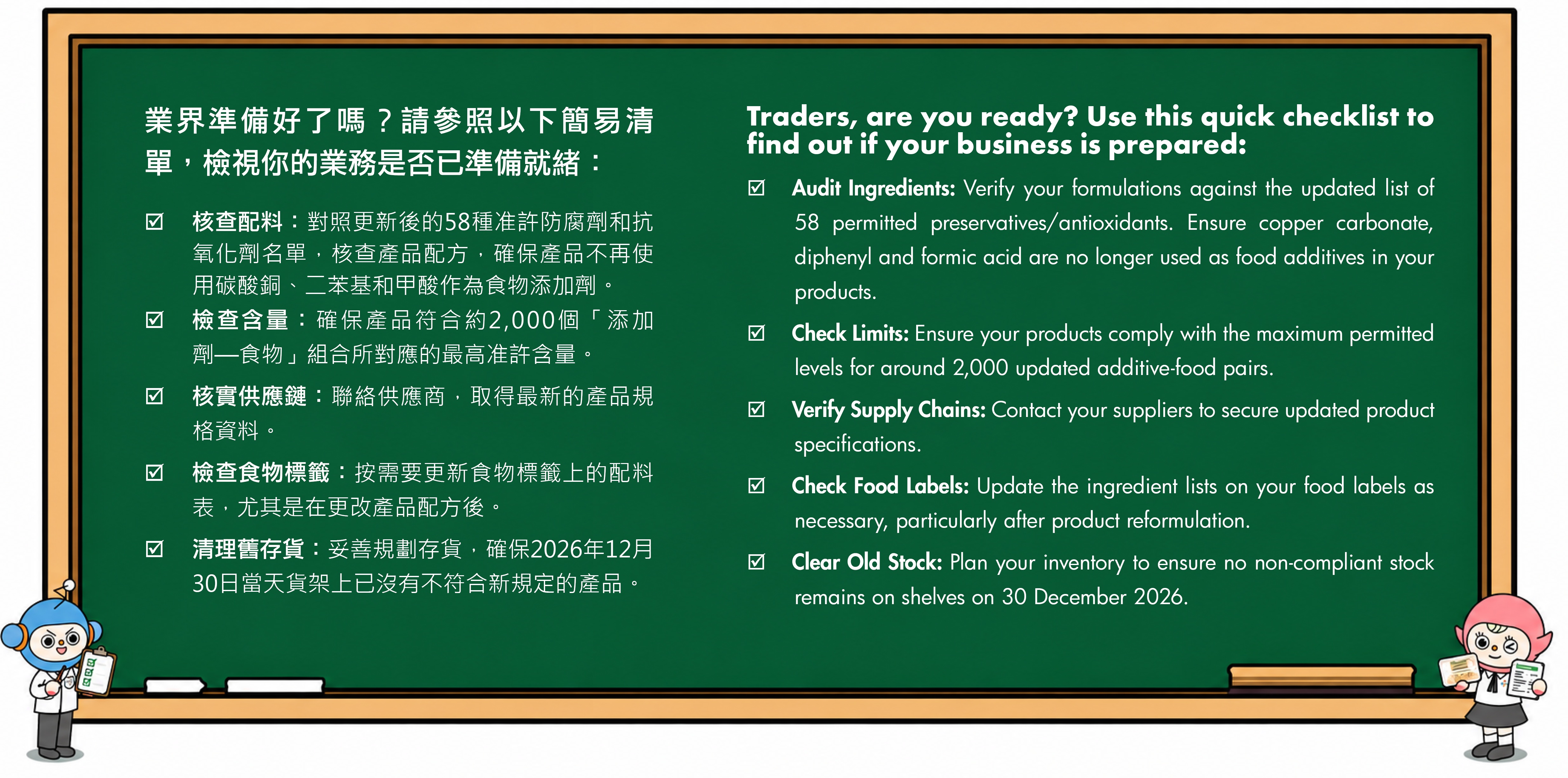
Illustration 3: A quick checklist that helps the food trade to evaluate their current state of readiness
Work Together for Better Food Safety
The amended Cap. 132BD represents a significant step forward in aligning Hong Kong's food safety regulation with international standards. With the Codex standards adopted as the backbone and supplemented with standards from the Chinese Mainland and major trading partners of Hong Kong, the amended Cap. 132BD enhances consumer protection while facilitating the food trade.
As with other food additives, the public is advised to read food labels carefully to make an informed choice and maintain a balanced and varied diet. On the other hand, the trade is encouraged to make full use of the CFS' resources to ensure all products fully comply with the amended Cap. 132BD from 30 December 2026.