


Food Safety Focus (243rd Issue, October 2026) – Article 2
"Lunch Break, No Outbreak":
How to Keep School Lunch Safe?
Reported by Patrick CHIU, Research Officer,
Risk Communication Section, Centre for Food Safety
With the new school term underway, schools and childcare facilities may provide their students with lunch meals, either from external meal suppliers or prepared by school kitchens. Improper food handling may pose significant food safety risks, particularly for young children, who are more susceptible to foodborne illness. Schools and childcare facilities, together with the Parent-Teacher Associations (PTA), play an essential role in collectively safeguarding food safety in schools. This article discusses key considerations when selecting meal suppliers and provides other food safety tips to observe on campus.
Selection of Meal Supplier
To safeguard the health of students, schools and childcare facilities can exercise careful consideration when selecting meal suppliers. Selected suppliers must hold a “Food Factory (Approved to Supply Lunch Boxes) licence” issued by the Food and Environmental Hygiene Department (FEHD). The contract with the supplier can set out the food choices, preparation standards, temperature and time controls during processing and delivery, as well as storage and distribution methods for the lunch meals. Schools and childcare facilities may wish to consider suppliers that have established a food safety management system with certifications (e.g. Hazard Analysis Critical Control Point (HACCP) or ISO 22000) and conduct a duty visit to the supplier's food premises between school terms to ensure that proper hygiene conditions are maintained.
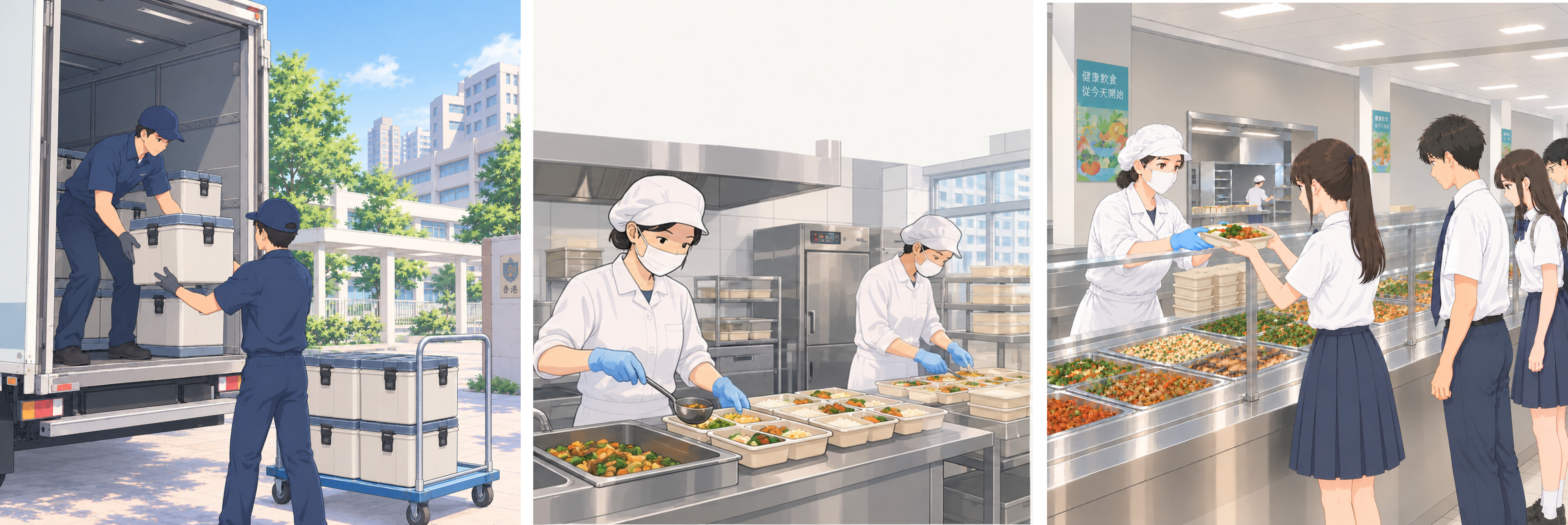
Figure 2: Common modes of organising school lunches by schools and childcare facilities, namely lunch boxes, portioning food on-site and buffet meals
Food Safety Tips to Observe on Campus
Cooking and Reheating
Both cooking and reheating are essential and effective procedures to eliminate pathogens in food. If school lunches are cooked or reheated in school kitchens, food should be thoroughly cooked or reheated, with its core temperature reaching at least 75˚C for at least 30 seconds. To avoid food preparation too far in advance, school kitchens are advised to plan ahead for the cooking or reheating processes.
Safe Temperature
Improper storage temperature can lead to the rapid growth of bacteria, particularly Bacillus cereus and Clostridium perfringens, in cooked meals. If lunch meals are prepared in suppliers’ kitchens in advance for delivery, schools are advised to maintain good communication with the suppliers and delivery service providers to minimise the time that food is exposed to the temperature danger zone (between 4˚C and 60˚C).
Regardless of the mode of organising school lunches, cooked food should always be stored at a safe temperature (e.g. hot food at above 60˚C; cold food at 4˚C or below) using either hot-holding or cold-holding equipment and following the 2-hour / 4-hour rule to prevent bacterial growth in food.
Distribution
Upon arrival at schools, lunch boxes should be distributed to students as soon as possible. If lunch meals are portioned on site at schools or served in a buffet-style arrangement, a clean and adequate space, appropriate equipment (e.g. electric warming devices), and sufficient manpower are needed to facilitate efficient distribution. Staff responsible for food distribution can help prevent cross-contamination by practising good personal hygiene. If any irregularities (e.g. insufficient hot-holding temperatures or physical contamination) are observed during the distribution of lunch meals, schools should notify the meal suppliers and take immediate rectifying measures.
Menu Planning
Schools and childcare facilities can regularly liaise with suppliers to ensure that the menus offer a balanced and varied diet for students, particularly by providing food choices that are lower in sodium and sugar. As young children are more susceptible to foodborne illness, high-risk foods (e.g. sunny-side-up eggs, sushi and sashimi) should be avoided on the menu, and safer alternatives can be chosen for students to minimise the risk of foodborne disease.
Choking Hazards
For young children, there may be a risk of choking while eating, especially when they do not chew food thoroughly or try to swallow it whole. As such, schools and childcare facilities should take extra caution to specific foods. Teachers and caregivers are advised to reinforce good eating habits among young children, so as to reduce choking risks at school.
To enhance food safety and hygiene awareness among schools, the CFS and the Environmental Hygiene Branch of the FEHD have stepped up inspections of licensed food factories supplying school lunch boxes in various districts of Hong Kong. In addition, the CFS has launched a thematic website “Safe Food at School” to help schools and childcare facilities coordinate all aspects of food safety in order to build a safe and healthy eating environment for students and young children.