



Food Safety Focus (237th Issue, Apr 2026) – Article 2
Atypical Bovine Spongiform Encephalopathy – Should we be Worried?
Reported by Dr. Ivan CHONG and Dr. Raymond CHEUNG, Veterinary Officers,
Veterinary Public Health Section, Centre for Food Safety
Bovine Spongiform Encephalopathy (BSE), widely known as "mad cow disease", triggered a global food safety crisis in the 1990s due to its link to variant Creutzfeldt-Jakob Disease (vCJD) in humans. While decades of coordinated international efforts have led to a remarkable decline in classical BSE cases worldwide, its lesser-known relative, atypical BSE, continues to surface in isolated cases. This article examines the key differences between classical and atypical BSE. By understanding the features of atypical BSE and the available epidemiological evidence, we can assess whether this lesser-known variant warrants public health concern.
Origins and Transmission
Classical BSE emerged in the 1980s as a consequence of recycling ruminant proteins in cattle feed. The practice of supplementing feed with rendered tissues from infected cattle allowed prions (misfolded proteins that cause BSE) to amplify through herds, creating an exponential transmission cycle that affected millions of animals and led to human vCJD cases through consumption of contaminated beef products.
Atypical BSE, first identified in 2003 through enhanced surveillance, presents a different picture. It occurs spontaneously in older cattle, typically aged eight years or more, with no connection to contaminated feed. Although the precise pathogenesis is not yet fully understood, scientists believe that age-related protein misfolding or genetic factors may trigger the condition. Unlike classical BSE, there is to date no evidence of natural field transmission of atypical BSE between animals or to humans, making each case an isolated event.
Food Safety Implications
The food safety risks of classical and atypical BSE differ significantly. Classical BSE posed clear risks, with indications that vCJD could be acquired through the consumption of contaminated beef products. Control measures such as bans on ruminant proteins in cattle feed and removal of tissues with greatest infectivity (e.g. brain and spinal cord) from the food chain were implemented in affected countries to eliminate these risks. According to the World Organisation for Animal Health (WOAH), the incidence of classical BSE has fallen dramatically and is now negligible, with nearly zero cases per million bovines.
Atypical BSE, on the other hand, has not been linked to vCJD and occurs spontaneously in older cattle at a negligible rate; which, when combined with existing food safety measures such as ante-mortem inspection and health certification systems, makes human exposure highly unlikely. In addition, the same protections that brought classical BSE under control (e.g. feed bans and removal of tissues with greatest infectivity) can also prevent atypical BSE prions from entering the human food chain. After nearly two decades of global monitoring, no human cases have been linked to atypical BSE, though researchers continue to study its theoretical risks
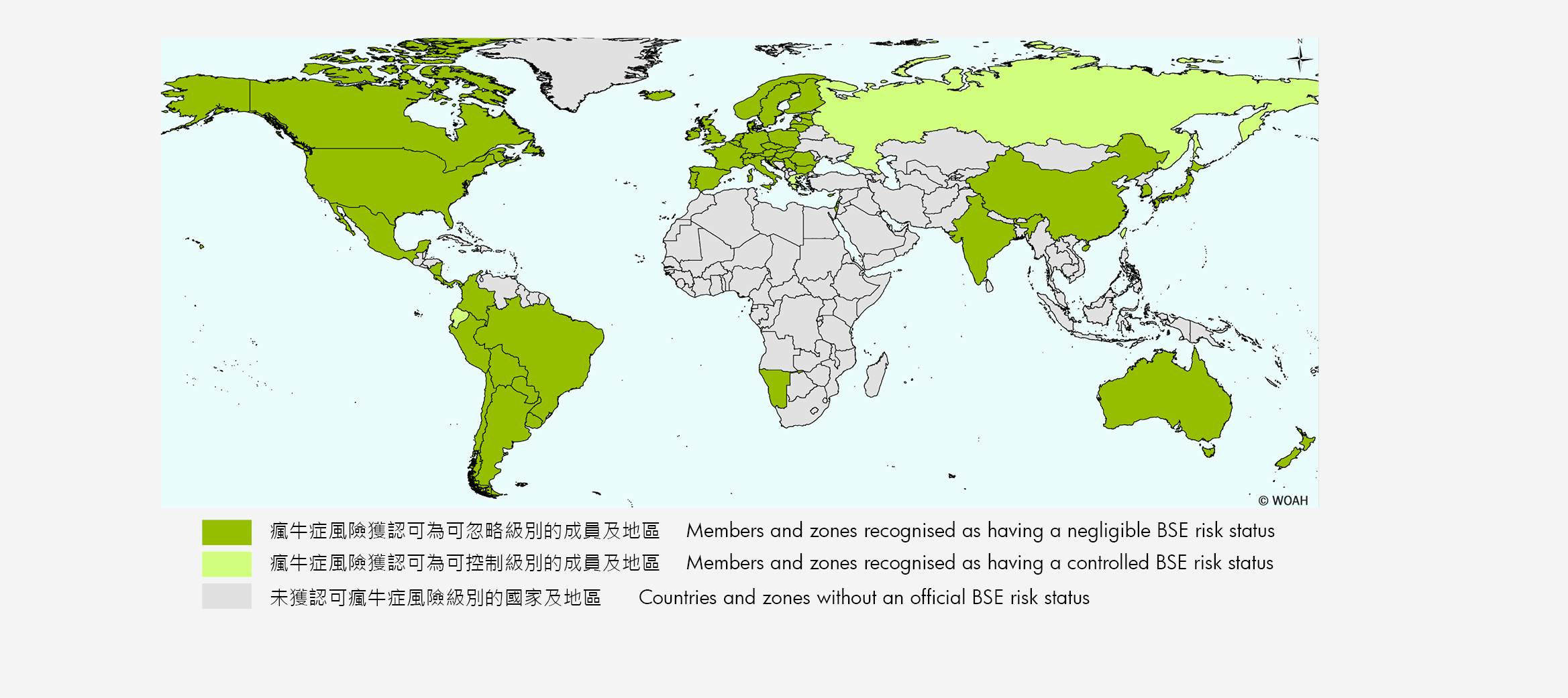
Figure: Map of BSE Official Status by WOAH (As of June 2025)
Regulatory Response
WOAH mandates distinct responses to classical and atypical BSE, reflecting their differing risks to animal and human health. Classical BSE, as a WOAH-listed disease, triggers international reporting obligations and strict containment measures. When a classical BSE case is detected, the affected country must notify WOAH, conduct trace-back investigations, impose quarantines on exposed herds and review feed ban compliance. WOAH officially recognises a country’s BSE risk status, from the lowest risk level “negligible”, to “controlled” and the rest as “undetermined”, after evaluating its history with classical BSE, implementation of the feed ban and disease surveillance, with trade guidelines aligned to each risk status. In Hong Kong, beef should be imported from countries or areas that meet public health requirements corresponding to the WOAH official BSE risk status.
In contrast, atypical BSE has been delisted by WOAH as a notifiable disease since 2023, due to its rare and sporadic nature and the finding that it has no significant impact on animal or public health. Detection of an atypical BSE case does not require emergency reporting or trade disruptions. However, as a precautionary measure, WOAH requires members to provide evidence that any bovines detected with atypical BSE have been completely destroyed or disposed of to ensure they do not enter the feed or food chain. As atypical BSE occurs spontaneously at a low rate in all cattle populations, its detection would not impact a country’s WOAH risk status.
Conclusion
Unlike classical BSE, atypical BSE is not known to spread naturally between animals or through feed, occurring only as rare, isolated cases in older cattle. The same protective measures developed in response to classical BSE provide robust protection against this sporadic form of the disease. WOAH’s decision to delist atypical BSE further underscores that it has no significant impact on public health. Decades of global surveillance have confirmed these safeguards work, with no human cases linked to atypical BSE.