

Food Safety Focus (237th Issue, Apr 2026) – Article 1
Review of Food Incidents in 2025
Reported by Dr. Ka-yun LAM, Medical & Health Officer,
Risk Management Section, Centre for Food Safety
The Centre for Food Safety (CFS) has put in place the Food Incident Surveillance System (FISS) to systematically monitor and identify food incidents occurring outside Hong Kong that might pose potential risks to local food safety. In addition, the CFS actively engages in international food safety networks, including the International Food Safety Authorities Network (INFOSAN) and the Rapid Alert System for Food and Feed (RASFF), and maintains close communication with Consulates-General, other food safety authorities and the media to ensure prompt information sharing and an effective response.

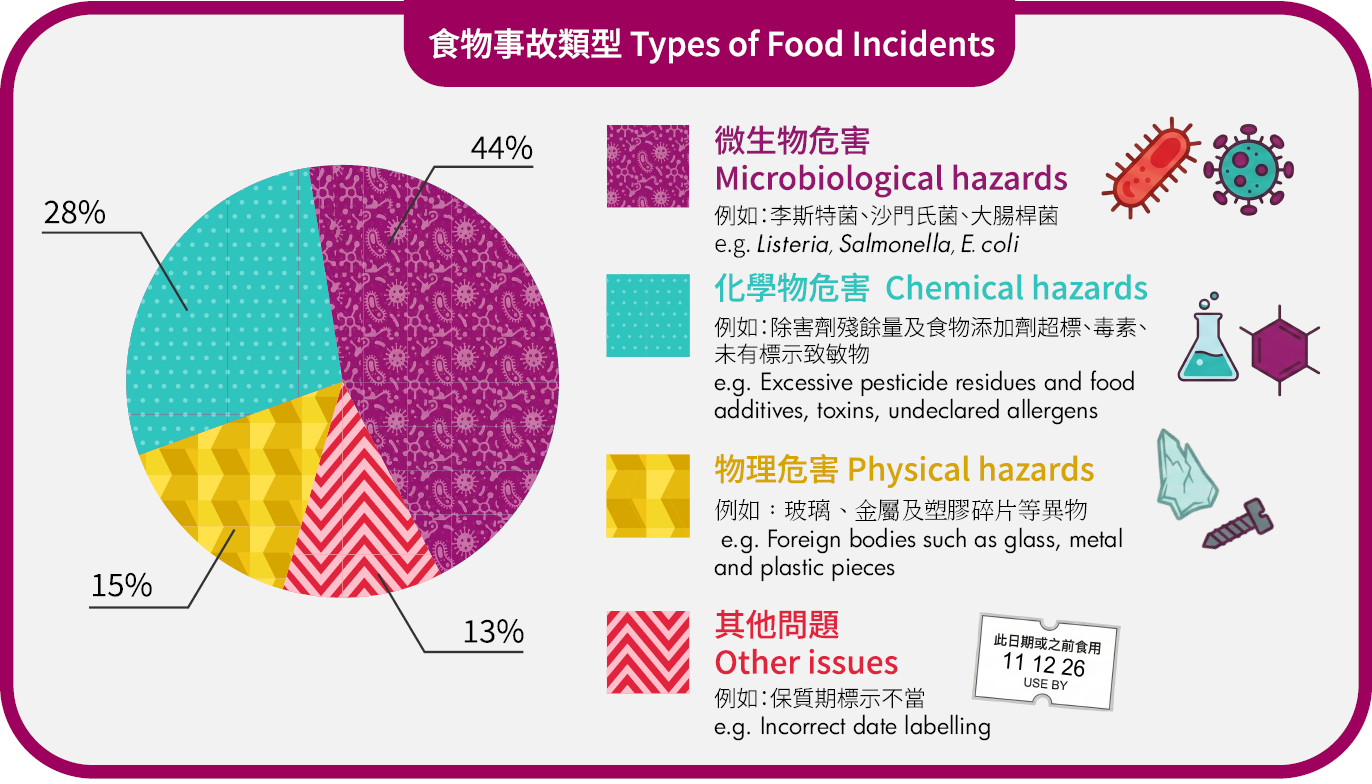
Figure: Types of food incidents with public announcements made in 2025
Food Incidents in 2025
Through the FISS, the CFS identified about 5,300 food incidents globally in 2025. For food incidents with potential local implications, the CFS followed up by carrying out sales checks with local traders, liaising with relevant authorities as well as reviewing import records in order to verify the local availability of the affected products. For affected products found to be locally available, the CFS implemented various risk management actions after taking into consideration relevant local regulations and risk assessment. These risk management actions included ceasing the sales of the affected products, conducting product recalls, enhancing surveillance of relevant products and suspending imports as appropriate.
With respect to risk communication, the CFS informed consumers and the trade by issuing press releases, trade alerts and food/allergy alerts for products with local availability. As for impacted products that were not available in the local market, the CFS released the information through food incident posts.
In 2025, the CFS issued 506 food incident posts, 25 press releases, 24 trade alerts and 18 food/allergy alerts, involving chemical hazards (e.g. use of excessive food additives, toxins), microbiological hazards (e.g. Listeria, Salmonella, Norovirus), physical hazards (e.g. foreign matter), and other issues (e.g. incorrect date labelling). The majority of the food incidents were related to microbiological and chemical hazards, accounting for 44% and 28% respectively.
Risk Management of Food Incidents
The following cases illustrate how the CFS responds proactively to serious food incidents that happened outside Hong Kong, and how the CFS manages food incidents effectively through collaboration with international food safety networks.
Imported raw milk cheeses with possible Shiga toxin-producing E. coli (STEC) contamination
In February 2025, the CFS received notifications from the RASFF that batches of raw milk cheese from France were being recalled due to possible contamination by STEC, and two of the affected batches were distributed to Hong Kong. Upon receipt of the notifications, the CFS immediately followed up with the concerned importers. The CFS instructed the importers to stop selling, remove from shelves and initiate a recall of the affected products. Press releases and trade alerts were issued.
At times, there are reports of raw (unpasteurised) milk cheese being contaminated with pathogens like STEC and Listeria monocytogenes. STEC are the pathogenic strains of E. coli that can produce the Shiga toxin, which may lead to severe illnesses, such as bloody diarrhoea and haemolytic-uraemic syndrome.
CFS's work on the incident of frozen shrimp products from Indonesia with potential contamination with Cesium-137
In August 2025, the CFS identified notices issued by the Food and Drug Administration of the United States regarding the recall of frozen shrimp products from Indonesia with potential contamination with Cesium-137. The CFS conducted sales checks for the concerned shrimp products and none were found on sale locally. Food incident posts were issued to alert the public and the trade. The CFS stepped up surveillance efforts for relevant frozen shrimp and seafood products and the results were all satisfactory.
Radioactive caesium, such as caesium-134 (Cs-134) and caesium-137 (Cs-137), can be released during nuclear emergencies. External exposure to large amounts of radioactive caesium can cause burns, acute radiation sickness and even death. Exposure to radioactive caesium can increase the risk for cancer. Internal exposure to radioactive caesium, through ingestion or inhalation, allows the radioactive material to be distributed in the soft tissues, especially muscle tissue, increasing cancer risk.
Conclusion
With the support of the FISS and ongoing collaboration with international food safety networks, the CFS manages food incidents and upholds local food safety in a proactive and effective manner.