


Food Safety Focus (236th Issue, March 2026) – Article 1
Review of Food Poisoning Outbreaks Related to Food Premises and Food Business in 2025
Reported by Dr. Jessica OR, Medical & Health Officer and Dr. Choi Yuk Kiu,
Senior Medical & Health Officer, Risk Management Section, Centre for Food Safety
This article reviews the food poisoning outbreaks (FPO) related to local food premises and food businesses referred to the Centre for Food Safety (CFS) of the Food and Environmental Hygiene Department (FEHD) in 2025.
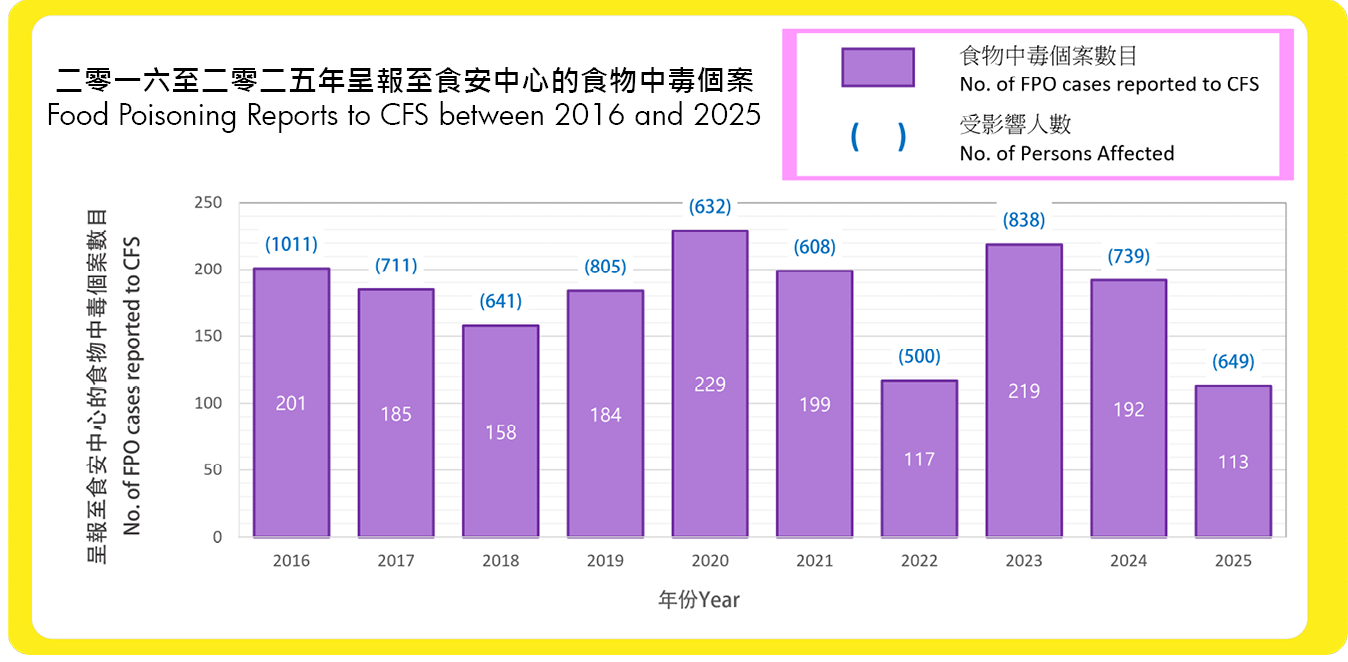
FPO is a statutory notifiable disease in Hong Kong under the Prevention and Control of Disease Ordinance (Cap. 599). Medical practitioners are required to notify the Department of Health (DH) of all suspected FPO. The number of reported FPO related to food premises fluctuated in the past decade, ranging from 113 to 229 cases per year. In 2025, the CFS received 113 FPO referred by the DH, affecting 649 individuals. The number of cases this year is the lowest in the past decade.
Upon receiving notification, the CFS conducted inspections to all the concerned food premises for investigation, reviewed food preparation and implemented prompt control measures to ensure food safety.
Causative Agents and Contributing Factors
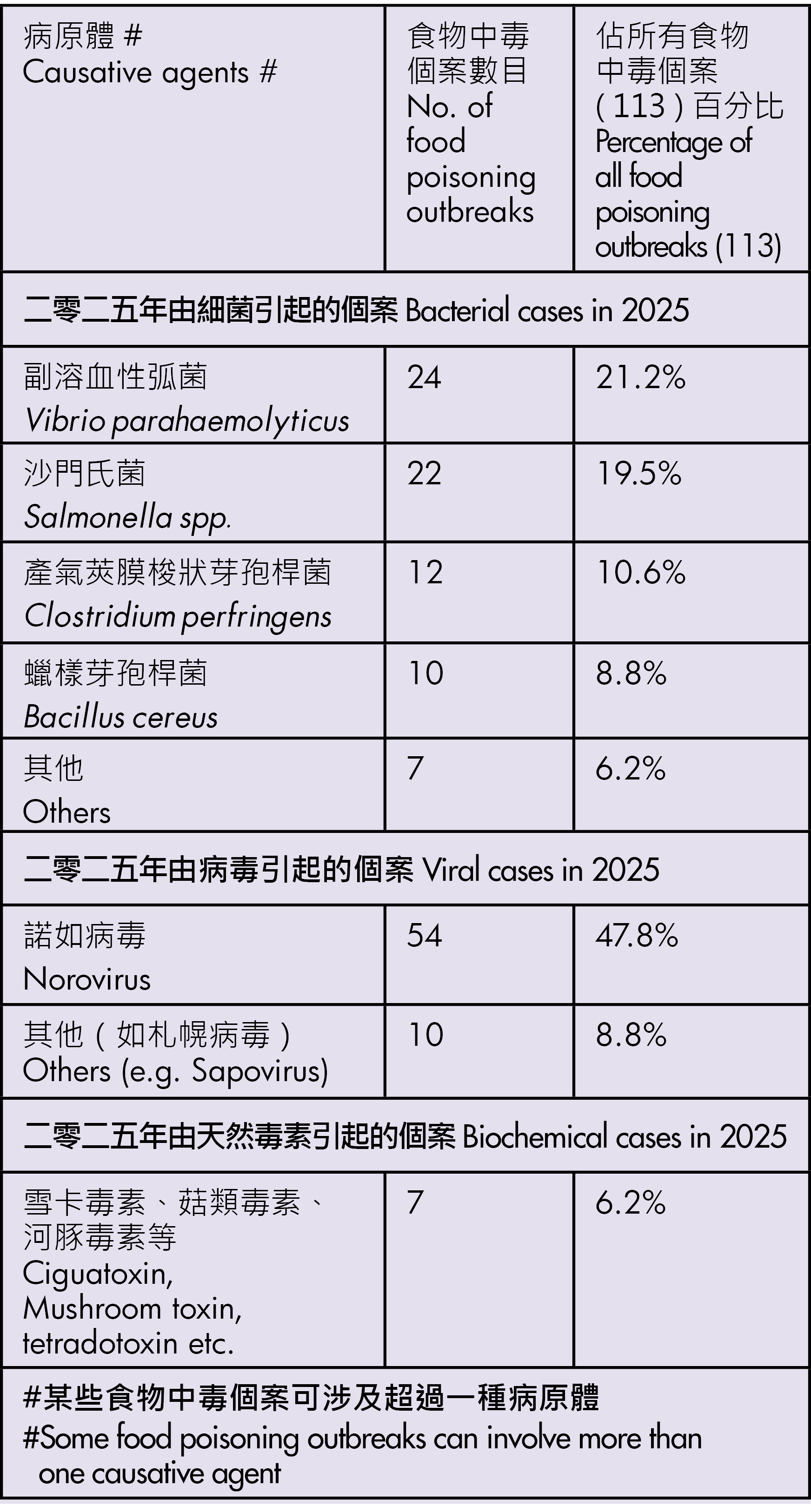
As some of the FPO reported by the Centre for Health Protection in 2025 involved more than one pathogens, resulting in the total percentage of causative agents exceeding 100%. In all the FPO recorded by the CFS in 2025, bacterial foodborne agents remained the major causes. Among 113 cases recorded, 64 (56.6%) were attributed to bacterial causes. The top three bacteria among all bacterial cases were Vibrio parahaemolyticus (24 cases, 21.2%), Salmonella. (22 cases, 19.5%) and Clostridium perfringens (12 cases, 10.6%). Viral cases (55 cases) accounted for 48.7% of FPO in 2025, and 54 cases were related to norovirus. The remaining 6.2% of FPO were related to biochemical cases (e.g. ciguatoxin, tetrodotoxin, shellfish toxin). Overall, "consumption of raw food" (38.9 %), "improper holding temperature" (25.7%) and "contamination by raw food" (23.9%) were the three most common contributing factors in all FPO in 2025.
i. Food Poisoning Outbreaks involving Norovirus in 2025
Consumption of ready-to-eat raw oysters accounted for more than half (33 cases, 61.1%) of these norovirus FPO, while other cases were linked to the consumption of undercooked seafood other than raw oysters and contaminated ready-to-eat foods, such as siu mei, by raw food. The number of raw oyster FPO decreased as compared to 2024.
For ready-to-eat raw oysters, oysters feed by filtering a large volume of seawater and absorbing suspended food particles therein, bacteria (e.g. Vibrio parahaemolyticus) and viruses (e.g. norovirus) may accumulate in them if they are grown in or harvested from contaminated water. Upon notification of these cases related to raw oysters, the CFS conducted investigations at all the restaurants involved, reviewed their food handling procedures, traced the sources of the oysters and implemented immediate control measures.
Besides, inadequate cooking in shellfish remains a significant risk factor for FPO. To achieve thorough cooking of shellfish, a minimum core temperature of at least 90°C for 90 seconds should be reached before serving. It is also advisable for susceptible populations to avoid eating raw or undercooked foods altogether.
ii. Food Poisoning Outbreaks linked to Salmonella
Among the 113 FPO reported in 2025, 22 cases were associated with Salmonella. Eggs are often identified as an incriminated food or a source of contamination for other ready-to-eat foods. In 2025, the CFS recorded food poisoning cases related to the consumption of undercooked eggs and raw unpasteurised eggs. It was also noted that cross-contamination of ready-to-eat food, such as siu mei, can occur when food handlers fail to practise proper handwashing after handling unpasteurised eggs. To prevent food poisoning related to Salmonella and eggs, the CFS provides practical advice on the safe handling and preparation of eggs:
Firstly, shell eggs should be stored in a cool, dry place, ideally in the refrigerator, after receipt. Secondly, pooling eggs—where eggs are cracked into a container and combined for multiple servings—should be minimised to prevent contamination from an infected egg. If pooling is necessary, any pooled eggs must be stored at or below 4°C. Furthermore, unpasteurised eggs should be cooked thoroughly, reaching a core temperature of at least 75°C, or until the texture becomes firm. It is common for dishes like scrambled eggs, often found in Hong Kong-style meals, to be undercooked for a smooth texture; in such instances, pasteurised eggs should be used.
The public is reminded to prioritise ordering fully cooked eggs over raw or undercooked options, especially for susceptible groups such as pregnant women and the elderly.
Conclusion
In summary, FPOs in Hong Kong have reached their lowest level in 2025 as compared with statistics in the past decade. The trend has fluctuated over the years. This reduction observed in 2025 is multifactorial, and may be a result of the collaborative efforts between the food trade and the Government. Moving forward, the CFS remains committed to safeguarding public health through evidence-based surveillance, the promotion of the “Five Keys to Food Safety” and close cooperation with all stakeholders.