


Food Safety Focus (234th Issue, Jan 2026) – Article 2
Reducing Aflatoxin Contamination in Foods
Reported by Dr. John LUM, Scientific Officer,
Risk Assessment Section, Centre for Food Safety
In November 2025, the Centre for Food Safety (CFS) issued a press release regarding a prepackaged pistachio paste suspected to be contaminated with aflatoxins. Aflatoxins are mycotoxins (toxic substances naturally produced by moulds) that can pose health risks to humans. Ingesting large doses of aflatoxins can result in acute poisoning, while long-term consumption of food contaminated with aflatoxins can cause liver cancer. In this article, various practices used to reduce and prevent aflatoxin contamination in food will be discussed.
What are aflatoxins and why are they found in food?
Among different types of aflatoxins identified, aflatoxins B1, B2, G1 and G2 are of particular health concern in humans, and are produced by certain moulds, including Aspergillus flavus and Aspergillus parasiticus. Under certain temperature (>10 ºC) and humidity (relative humidity >70%) conditions, these moulds can grow and produce aflatoxins. Foods that are more frequently contaminated by aflatoxins include cereals, oilseeds, spices and tree nuts. Aflatoxins M1 and M2 can also be found in the milk of animals that are fed with contaminated feed.
What can be done to reduce aflatoxin contamination in foods?
Aflatoxin contamination can occur during various stages of food production, i.e. crops growing in the field, during post-harvest operations and in storage. Therefore, an integrated control approach covering the whole chain of food production is necessary to prevent aflatoxin contamination effectively.
Aflatoxin-producing moulds cannot grow in properly dried and stored foods. Therefore, efficient drying of food and maintenance of the dry state through proper storage are the most effective measures against aflatoxin contamination. Other important practices that are effective in reducing aflatoxin contamination are further discussed below.
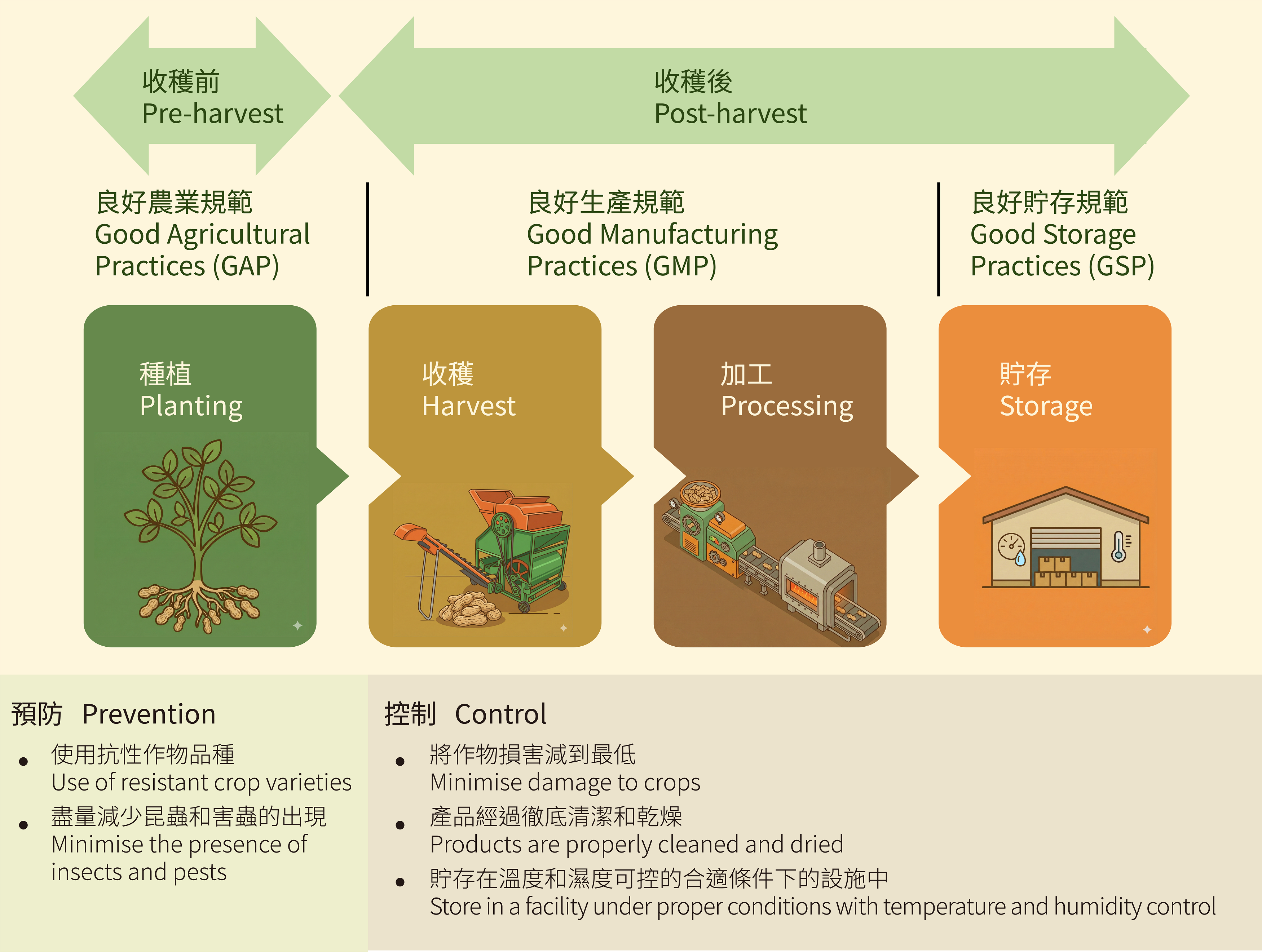
Figure: An integrated control approach should be adopted to reduce aflatoxin contamination in the whole chain of food production.
Pre-harvest stage
Control of aflatoxin contamination during crop growth in the field is achieved by minimising insect infestation, since pests could attack crops and make them more susceptible to mould infection and aflatoxin contamination. As such, it is important to use crop varieties that are resistant to insect and mould infections. Moreover, the presence of pests in the growing field should be minimised by adopting an effective pest management system.
Post-harvest stage
During the post-harvest stage, damage to crops should be avoided since this can lead to invasion by aflatoxin-producing moulds. After harvesting, crops should be properly cleaned, dried and stored under optimised conditions in a warehouse equipped with temperature and humidity controls.
To sum up, it is important for food producers to adopt Good Agricultural Practices (GAP) during the pre-harvest stage. During the post-harvest stage, it is critical to implement Good Manufacturing Practices (GMP) and Good Storage Practices (GSP) during the handling, processing, storage and distribution of these foods for human consumption.
How can consumers reduce their exposure to aflatoxins?
Food should be purchased from reliable sources and stored properly in a cool and dry place. Moreover, food should not be stored for extended periods of time, and mouldy or damaged food should be discarded. Lastly, maintaining a balanced and varied diet can avoid excessive exposure to contaminants including aflatoxins from a small range of food items.
Regulation of aflatoxins in food in Hong Kong
In Hong Kong, regulatory limits for aflatoxins in food are stipulated in The Harmful Substances in Food Regulations (Cap. 132AF). The maximum limits of aflatoxins in certain tree nuts, peanuts and dried fruit which are more susceptible to aflatoxin contamination have been established, by making reference to Codex Alimentarius Commission (Codex) standards. The CFS has also issued a set of Guidance for Trade on the Prevention and Reduction of Aflatoxin Contamination in Peanuts to provide guidance for the food trade to prevent and reduce aflatoxin contamination.
Efforts of international organisations to reduce aflatoxins in foods
Aflatoxin contamination of food is of global concern. The World Health Organization, in collaboration with the Food and Agriculture Organization, has assessed the risks of aflatoxin contaminated foods and recommended measures to control the contamination. Codex has established food safety standards for aflatoxins in food and issued various Codes of Practice for the prevention and reduction of aflatoxin contamination in various foods, such as tree nuts, peanuts and dried figs.
Key Points to Note
- Aflatoxin contamination can occur throughout the whole chain of food production and an integrated control approach is necessary to prevent contamination effectively.
- In general, efficient drying of food commodities and maintenance of the dry state through proper storage is the most effective measure to prevent aflatoxin contamination.
- By making reference to Codex, Hong Kong has established regulatory limits for aflatoxins in various The CFS has also issued trade guidelines to prevent aflatoxin contamination.