



Food Safety Focus (228th Issue, July 2025) – Article 2
Ensuring Food Safety During Summer - Challenges and Best Practices
Reported by Mr. Kenneth YIP, Scientific Officer,
Risk Communication Section, Centre for Food Safety
Summer is a fun time filled with happiness, and tasty meals shared with family and friends ranging at both indoor locations like schools and party rooms and outdoor venues such as beaches and yachts. However, previous food poisoning outbreaks at summer events starkly remind us that the increased volumes of food preparation, large gatherings and extended meal times raise the risk of food poisoning outbreaks. Common challenges including cross-contamination and improper storage temperatures can easily turn celebrations into health hazards. In general, food poisoning organisms grow well in summer, and the growth rate of microbial cells doubles when the temperature increases by 10°C until it reaches the optimal growth temperature. The optimal temperature for the growth of Vibrio parahaemolyticus and Staphylococcus aureus are 37°C. This article will explore major food safety challenges during large food gatherings in summer, and share practical tips to keep meals safe and fun for everyone.
Encountering the Challenges – Cross-contamination and Improper Temperatures
Food preparation areas and kitchens often handle a variety of items including raw, ready-to-eat (RTE) and cooked foods. Cross-contamination can occur when these foods are handled by using the same sets of utensils, kept in the same storage compartments or processed in the same area in close proximity. Certain high-risk ingredients, such as eggs contaminated with Salmonella or oysters carrying norovirus, pose significant food safety threats if not handled and or processed properly. Contamination can also occur if food handlers do not properly wash their hands during food preparation. The consumption of contaminated food can lead to foodborne illness.
Another critical risk is improper temperature control, which allows food to remain in the Temperature Danger Zone from 4°C to 60°C, which facilitates the proliferation of food poisoning-causing bacteria. Large-scale food preparation in advance, incorrect defreezing procedures and insufficient staff can lead to food ingredients being left at unsafe temperatures for prolonged periods, especially in hot summer. In addition, some food serving methods like party catering services maylet food be displayed under conditions lacking proper temperature control, if the food is not properly handled. Some foods such as frozen confections may melt when they are stored at improper temperatures while other foods may harbour pathogen growth without obvious signs of spoilage.
Inadequate or uneven heat treatment can also lead to the survival and growth of microorganisms in foods after cooking. Dishes prepared in bulk, such as thick cuts of barbecued or smoked meats, may have undercooked portions underneath food surfaces. Similarly, frying and microwave oven heating may fail to deliver sufficient heat penetration, leaving portions of food at unsafe temperatures and allowing pathogens to survive and proliferate.
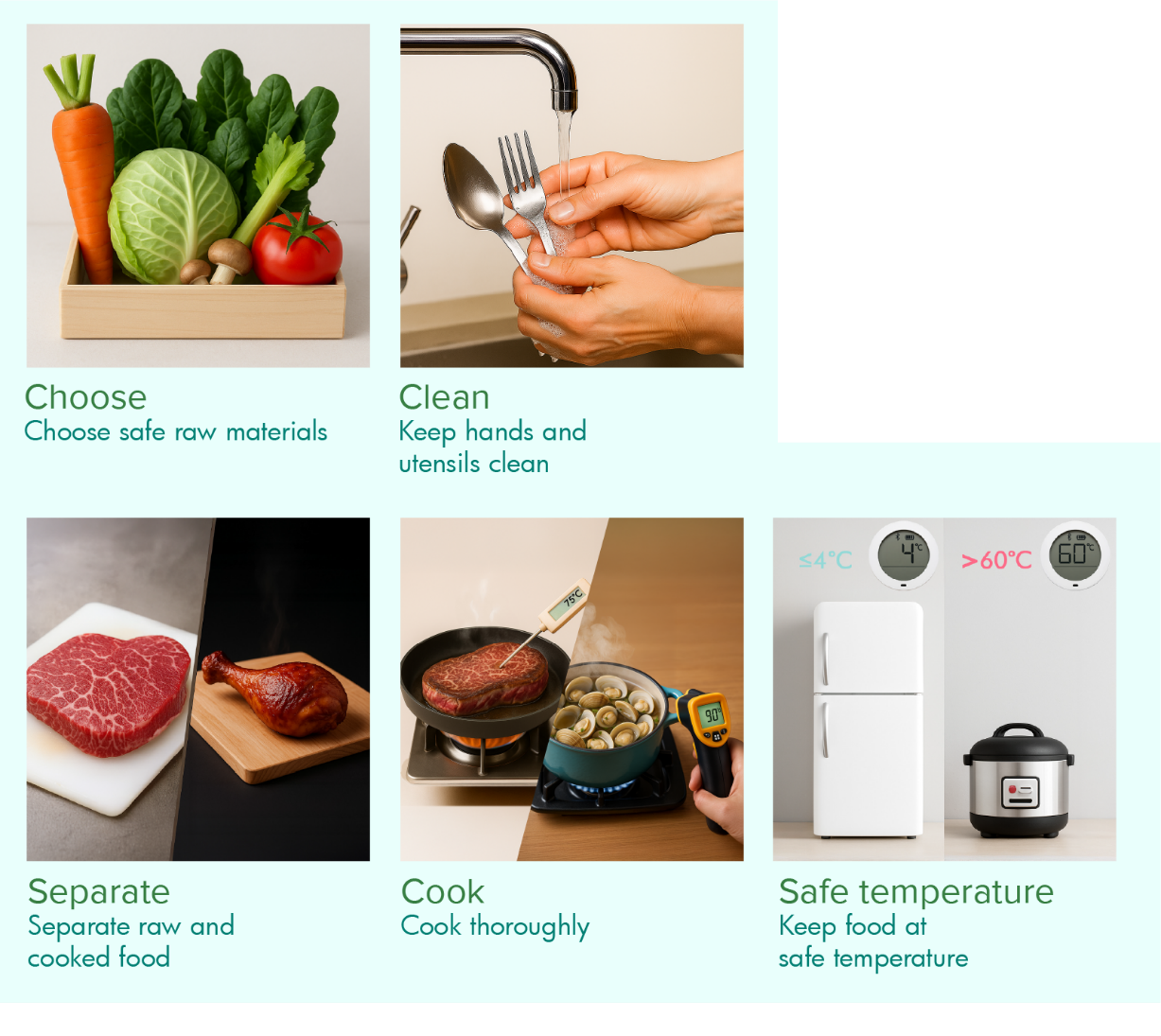
Figure : Five Keys to Food Safety
Best Practices to Reduce the Risks - Five Keys to Food Safety
To effectively minimise food safety risks, implementing the Five Keys to Food Safety is essential: (i) segregate food – store raw, RTE, and cooked items separately (ideally in different refrigerators). If foods share one unit, place raw foods in covered containers below RTE and cooked foods; (ii) prevent cross-contamination – use separate and dedicated utensils for raw, RTE and cooked foods in different food preparation areas with clear demarcation; ensure all utensils and equipment are properly sanitised before use; and (iii) wash hands – scrub with water and liquid soap for 20 seconds thoroughly to maintain good hand hygiene.
Maintaining safe food temperatures is critical to preventing spoilage and bacterial growth. Store RTE and cooked foods not for immediate use at ≤4°C (cold foods) or ≥60°C (hot foods). Defrost frozen foods only by moving them from the freezer to the fridge, placing them under cold running water or microwaving. Never leave them at room temperature to defrost. Adhere to the 2-hour/4-hour rule for food items in the Temperature Danger Zone (4–60°C).
To ensure foods are cooked thoroughly, insert a food thermometer into the centre of the thickest part of the food (avoiding bones and container walls) to confirm the core temperature reaches at least 75°C for at least 15 seconds. For oysters and shellfish, they have to be heated to 90°C for 90 seconds or boiled at 100°C and continued for 3 to 5 minutes. The thermometer should not touch a bone or the side of the container. If no food thermometer is available, cook or reheat food thoroughly, e.g., boiling soups and stews for at least 1 minute and cooking eggs until the yolks are firm. When microwaving, stir and rotate food between each heating cycle to eliminate cold spots and ensure even heat distribution.