Risk Assessment Studies
Report No. 4
Microbiological Hazards Evaluation
Sandwiches in Hong Kong
December 2000
Food and Environmental Hygiene Department HKSAR
Table of Contents
- Abstract
- Objective
- Introduction
- MicrobiologicalSurveillance on Sandwiches
- Results
- Discussion
- Conclusion& Recommendation
- References
- Figures
- Tables
- Appendix1: Microbiological Guidelines for Sandwiches
Abstract
Sandwich is one of the most popular fast food in Hong Kong. There are many styles of sandwiches available in local market, such as large sandwich chain stores, restaurants and supermarkets. In reviewing the microbiological surveillance findings on 1,023 sandwich samples collected from 1997 through 1999, 88 samples (8.6%) were found unsatisfactory in one or more microbiological tests. Trend analysis showed that the percentage of unsatisfactory samples decreased from 11.5% in 1997 to 9.9% in 1998 and then, to 3.8% in 1999. 82 out of 88 unsatisfactory samples (93.2%) failed in total bacterial count which reflects the hygienic quality of foods. The remaining 6 unsatisfactory samples were found unsatisfactory in the examination of pathogens. Salmonella species was detected in 3 samples in 1997 and in 1998. Listeria monocytogenes and Staphylococcus aureus were detected in 2 samples and 1 sample in 1998 respectively. Not all the ingredients for sandwiches are cooked and many preparation steps are done by bare hands. Therefore, ingredients and post cross-contamination are the two main pathways to contaminate the final products. Both the trade and consumers are advised to take necessary precautions to enhance food safety in preparation and consumption of sandwiches.
Risk Assessment Studies -
Microbiological Hazards Evaluation
Sandwiches in Hong Kong
- An Evaluation of Sandwiches Microbiological Surveillance 1997 - 1999
Objective
The aim of this paper is to evaluate the microbiological hazards of sandwiches. The food surveillance findings from 1997 through 1999 were reviewed and analyzed to determine the microbiological status of sandwiches available in the local market.
Introduction
- Sandwich is one ofthe most popular fast food in Hong Kong. They are also considered as lightmeals for lunch. As more people are eating-out, the commercially availablesandwiches may be their choice. Many different styles of sandwiches couldbe found in the menu in most restaurants. Large sandwiches chain stores maysupply other kinds of light refreshments such as bagel, roll, salad and fruitsto customers. Sandwiches can also be found in supermarkets.
- The classic sandwichconsists of one to two pieces of bread with filling in the middle. Differentfillings, such as meat, fish, egg, cheese, vegetables with or without sauces,may be used to prepare sandwiches according to customers' orders. Sandwichesmay be served cold or hot.
Production of sandwiches
- Most sandwiches availablein local market are commonly fresh-made in sandwich chain stores and restaurants.Pre-packaged sandwiches are also supplied from some food factories to retailoutlets and/or supermarkets thus involving delivery step in production.
- The production of sandwichincludes purchasing raw materials, filling preparation, assembly of breadand fillings, packaging, delivery and serving. The general production of sandwichesis illustrated in the flowchart at figure 1.
- Raw materials includeeggs, meat and poultry products, vegetables, bread and sauce. Some of theseraw materials, like eggs, meat, poultry products and vegetables must be processedfirst. Others such as breads and sauces, are usually readily available forimmediate use. In order to control the quality of food products, large sandwichchain stores purchase some ready-to-use fillings from the suppliers. Thesefillings normally packed and delivered in packages below 3kg per bag.
- The processing of rawingredients for fillings will undergo steps such as washing, cutting, marinating,cooking and mixing with salad dressings, depending on the styles of the fillings.Salad dressing may be added to bind ingredients in the fillings and improvetaste and texture of the products. In some instances, it may contribute preservativeeffect to food to a certain extent.
- When all ingredientsare ready to be used, "sandwiching" will follow. This refers to the assemblyof breads with fillings. Butter may be spread on bread and different styleof fillings may be put in between pieces of bread depending on consumer'schoice. Afterwards, sandwiches may be cut into triangular shape.
- The finished productmay be served immediately in shops or restaurants. Otherwise, the fresh-madesandwiches may be packed in factory and delivered to retail outlets or supermarketsfor sale.
Potential microbiological hazards
- Some high-risk ingredients,such as vegetables and eggs, are commonly used in sandwiches. Raw vegetablesare well known to be used in sandwich together with salad dressing commonly.Vegetables if not properly cleansed would be contaminated with Listeriamonocytogenes and Clostridium perfringens commonly found in soil(1).
- For Salmonella species,raw egg is one of the commonest food vehicles (2). Thepathogen may be introduced from raw materials to final products if the eggsused for the sandwiches are not cooked thoroughly.
- As sandwich preparationoften involves handling of pre-cooked or ready-to-eat ingredients, good personaland environmental hygienic practices should be observed to minimize the chanceof cross contaminations of microbiological hazards. Common pathogens transmittedthrough bare-hand handling are Salmonella spp. and S. aureus (1,3).
MICROBIOLOGICAL SURVEILLANCE ON SANDWICHES
- The microbiologicalexamination results of sandwiches from 1997 through 1999 are reviewed andanalyzed. The samples were taken by public health inspectors from retail outletsand examined by the Institute of Pathology, Department of Health. The microbiologicaltests for sandwiches included that of hygienic quality and specific pathogens.
- The food surveillanceresults were evaluated based on the departmental microbiological guidelinesfor ready-to-eat food. According to the guidelines, sandwiches are classifiedunder (i) sandwich without salad, and (ii) sandwiches with salad (Appendix1).
- The operational definitionfor sandwiches with salad refers to those with salad dressing as filling.For these sandwiches, a higher total bacterial count in the final productis allowed. However, the expected E. coli count which is an indicatorfor faecal contamination remained the same for both categories of sandwiches.They should also comply with the same requirement in terms of the specificpathogens.
RESULTS
- From 1997 to 1999,a total of 1,023 sandwich samples were taken for microbiological examinations(Table 1). Of these, 930 and 93 samples were sandwicheswithout salad and with salad respectively.
- Of the period understudy, 88 out of 1,023 sandwich samples (8.6%) were found unsatisfactory inone or more microbiological tests. Trend analysis showed that the percentageof unsatisfactory samples decreased from 11.5% in 1997 to 9.9% in 1998, andthen to 3.8% in 1999 (Table 1).
Hygienic quality
- The hygienic qualityof food is reflected in the total bacterial count (TBC) and total E. coli(total) count. From 1997 through 1999, 82 samples of sandwiches had unsatisfactorylevel of TBC and no sample was found unsatisfactory in E. coli (total)count.
- The distribution ofTBC in sandwiches was studied and presented in log-scale (figure2). It is shown that this is a clear demarcation at log10 counts of 6.00- 6.99 in which more than 90% of all samples fall under this category.
- When the results arestratified into sandwich without and with salad, it is shown that more than90% of sandwiches without salad are with the log10 count of 6.00 or less (figure3). The distribution pattern is same as the overall distribution of allsandwiches. The distribution pattern of sandwiches with salad, however, isextremely different (figure 4). Of the 93 samples beinganalysed, 18 samples (19.4%) gave log10 counts of more than 7.00.
- Although 8.6% of sandwichsamples with unsatisfactory results were found from 1997 to 1999, a decreasingtrend was observed (Year 1997 - 11.5%; Year 1998 - 9.9%; Year 1999 - 3.8%).The results reflected that the microbiological quality of sandwiches soldin local market has been improved in the past three years.
Specific pathogens
- From 1997 through 1999,only 0.6% (6 out of 1,407 samples) of the test samples failed in specificpathogen detection. 2 out of 6 unacceptable samples were contaminated withListeria monocytogenes. Salmonella species was detected in 3samples and one was found to contain Staphylococcus aureus (table2).
DISCUSSION
- The fact that barehands are involved in many of the production steps in sandwiches are providedan explanation why more than 90% of all unsatisfactory samples failed in TBC.However, most of the samples with low TBC in the past three years are evidenceto show that the food handlers involved in sandwich business have taken precautionto maintain good quality of sandwiches.
- Salmonella species,Staphylococcus aureus and Listeria monocytogenes couldbe introduced by food handlers and cross-contamination between ready-to-eatfoods and raw items.
- L. monocytogeneswere found in 2 out of the 6 unacceptable samples. Both these two sampleswere with cheese ingredient. Dairy products are good media to support thegrowth of L. monocytogenes at low temperature. However, all cheese productsmust be pasteurized before they are sold in market. Pasteurization could effectivelyeliminate Listeria monocytogenes. Therefore, precautionary measuresmust be taken in subsequent production steps to prevent the risk of potentialmicrobiological hazards.
- As for salmonellacontamination, the pathogen may be present in raw egg or introduced bycross-contamination during processing, such as preparation of vegetable salads.For eggs that are not cooked thoroughly, Salmonella species may befound or even multiplied in the finished products if the storage conditionssuch as nutrient contents, pH value, water activity and time favour for theirgrowth.
- Vegetables in sandwichesare frequently eaten raw. Lettuce, cucumber and tomato are the most commoningredients. It is therefore of paramount importance that these vegetablesshould be washed thoroughly to minimize the microbiological hazards. Disinfectantmay be applied to decrease the bacterial log. However, when such chemicalis used, the handlers must follow the instructions from the suppliers of thedisinfectants to prevent any chemical hazard being introduced into the finalproducts.
- Staphylococcus aureusis naturally present in human nasopharynx. Its presence obviously reflectspoor personal and food handling hygiene. Health education and good personalhygiene are important to prevent contamination of food by such bacterial agent.
CONCLUSIONS & RECOMMENDATIONS
- The food surveillancefindings reflected that food handlers involved in sandwich business have practicedthe principle of Good Manufacturing Practices (GMP) to maintain the qualityof their food products. However, sandwich is a perishable food item with shortshelf life (1 - 2 days). Therefore, the trade should take further precautionarysteps especially in the preparation of filling, in order to improve good hygienicquality of sandwich products. For the consumers, they should also observesome key points to eliminate microbiological hazards. The following are somerecommendations.
Advice to trade
-
Handling of raw materials -
- Choose fresh food ingredients.
- Obtain the raw materialsfrom reputable and reliable suppliers.
- Refrigerate the openedsalad dressing.
- Wash all vegetablesthoroughly.
- Cook egg and meat thoroughly.
-
Hygienic principles -
- Observe good personalhygiene and food hygiene.
- Prevent cross-contamination.
- Ensure optimal storagetemperature and duration.
Advice to consumer
The following are some clues for the consumers to understand how they can choose sandwiches with good quality -
- Buy sandwiches fromreputable and reliable suppliers.
- Check the "expiry date"and pay attention to the storage temperature of pre-packed sandwiches.
- Consume the sandwichesas soon as possible.
- If not consumed immediately,the sandwiches (including home-made ones) should be
- Packed and stored at0 - 4°C;
- Separated from rawfood;
- Consumed within 1 -2 days.
REFERENCE
- Adams MR & Moss MO.Food Microbiology. Cambridge: The Royal Society of Chemistry. 1995
- D'Aoust JY. Salmonella.In: Lund BM, Baird-Parket TC & Gould GW, editors. The Microbiological Safetyand Quality of Food. Maryland: Aspen Publishers, Inc. 2000. p. 1100-1135.2000
- Jay JM. Modern FoodMicrobiology. 5th edition. New York: Chapman & Hall. 1996.
- Ackman RG. Compositionand Nutritive Value of Fish and Shellfish Lipids. In: Fish and Fishery Products.United Kingdom: Cab international. p. 77-116. 1995.
Figure 1
Flow chart of sandwiches production
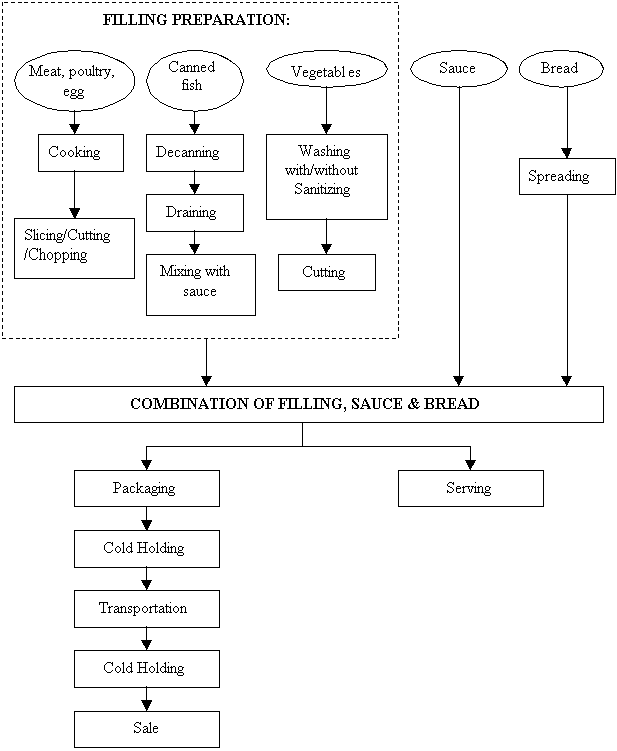
Figure 2
Total bacterial count of sandwiches (1997 - 1999)
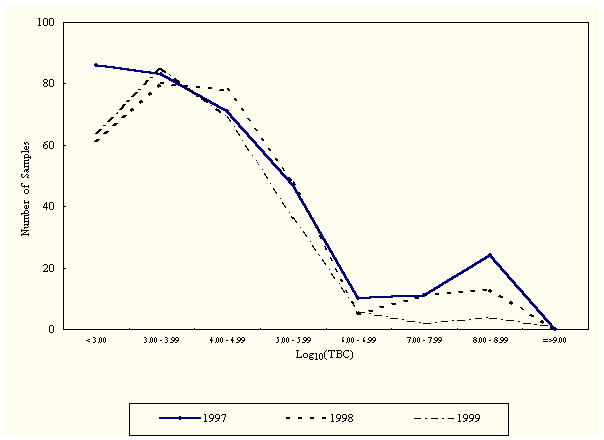
Figure 3
Total bacterial count of sandwich without salad (1997 - 1999)
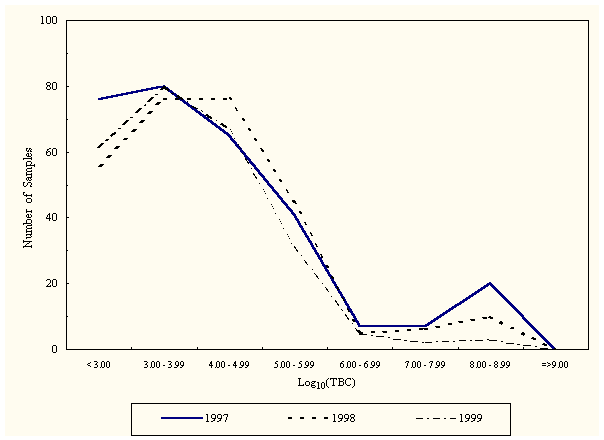
Figure 4
Total bacterial count of sandwich with salad (1997 - 1999)
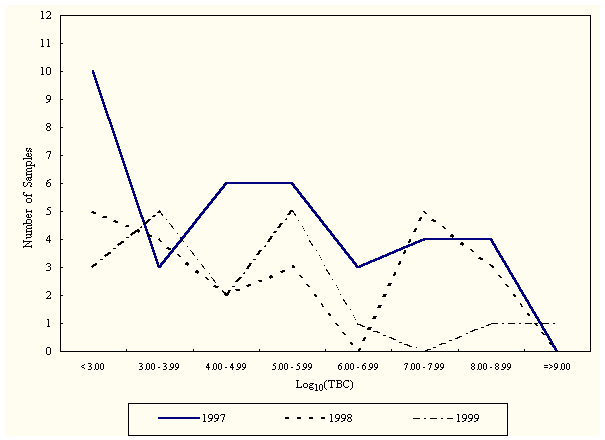
Table 1
Food surveillance findings from 1997 to 1999 (no. of sample)
| Food sample | 1997 | 1998 | 1999 | Total |
|---|---|---|---|---|
| Sandwiches without salad | 328 | 319 | 283 | 930 |
| Sandwiches with salad | 36 | 24 | 33 | 93 |
| All sandwiches | 364 | 343 | 316 | 1,023 |
Food surveillance findings from 1997 to 1999 (no. of unsat. sample and percentage)
| Food sample | 1997 | 1998 | 1999 | Total |
|---|---|---|---|---|
| Sandwiches without salad | 34(10.4%) | 26(8.2%) | 10(3.5%) | 70(7.5%) |
| Sandwiches with salad | 8(22.2%) | 8(33.3%) | 2(6.1%) | 18(19.4%) |
| All sandwiches | 42(11.5%) | 34(9.9%) | 12(3.8%) | 88(8.6%) |
Table 2
Description of unsatisfactory results (1997 - 1999)
| Year | No. of samples | Pathogens | Type of sandwich |
|---|---|---|---|
| 1997 | 1 | Salmonella species: present (Gp D) | Mixed vegetable sandwich with salad |
| 1998 | 1 | Staphylococcus aureus: 14,000 | Ham & egg sandwich without salad |
| 1998 | 2 | Salmonella species: present (Gp C) | Egg sandwich without salad |
| 1998 | 2 | Listeria monocytogenes: present | Cheese sandwich without salad; cheese & ham sandwich without salad |
| 1999 | 0 | --- | --- |
| Total | 6 | --- | --- |
Appendix 1
Microbiological guidelines for sandwiches *
Hygienic quality
| Aerobic Plate Count (APC) | |
|---|---|
| Withsalad | 107 /g |
| Withoutsalad | 106 /g |
| E. coli (total) | 104 /g |
Food safety
| Campylobacter spp. | absent in 25g |
|---|---|
| E. coli O157 | absent in 25g |
| L. monocytogenes | absent in 25g |
| Salmonella spp. | absent in 25g |
| V. parahaemolyticus | 103 /g |
| S. aureus | 104 /g |
| C. perfringens | 104 /g |
| B. cereus | 105 /g |
* The "Microbiological Guidelines for Ready-To-Eat Food" has been updated and the above guidelines may no longer be applicable. Please refer to the latest version at Microbiological Guidelines for Ready-to-eat Food.
This is a publication of the Food and Public Health Branch of the Food and Environmental Hygiene Department of HKSAR Government. Under no circumstances should the research data contained herein be reproduced, reviewed, or abstracted in part or in whole, or in conjunction with other publications or research work unless a written permission is obtained from the Department. Acknowledgement is required if other parts of this publication are used.
Correspondence:
Risk Assessment Section Food and Environmental Hygiene Department 43/F,
Queensway Government Offices,
66 Queensway,
Hong Kong.
Email: enquiries@fehd.gov.hk