Risk Assessment Studies
Report No. 15
Chemical Hazard Evaluation
RISK ASSESSMENT ON
ARTIFICIAL SWEETENERS
IN BEVERAGES
November 2003
Food and Environmental Hygiene Department
HKSAR
This is a publication of the Food and Public Health Branch of the Food and Environmental Hygiene Department of HKSAR Government. Under no circumstances should the research data contained herein be reproduced, reviewed, or abstracted in part or in whole, or in conjunction with other publications or research work unless a written permission is obtained from the Department. Acknowledgement is required if other parts of this publication are used.
Correspondence:
Risk Assessment Section
Food and Environmental Hygiene Department
43/F, Queensway Government Offices,
66 Queensway, Hong Kong.
Email: enquiries@fehd.gov.hk
Table of Contents:
Abstract
Objective
Introduction
Scope of Study
Methodology
Consumption Data
Sampling Plan
Laboratory Analysis
Dietary Exposures to Artificial Sweeteners from Beverages
Beverage Consumption Data
Concentration of Artificial Sweeteners in Beverages
Dietary Exposures to Artificial Sweeteners from Beverages
Conclusion and Recommendations
Advice to Trade
Advice to Consumers
Annex I: Summary Information on Artificial Sweeteners
Annex II: Distributions of Artificial Sweeteners in Beverages
Abstract
This study estimated the exposures to artificial sweeteners from beverages by secondary school students in Hong Kong and assessed the effects on their health. Five artificial sweeteners including acesulfame potassium, aspartame, cyclamic acid, saccharin and sucralose were studied.
Artificial sweeteners are substances which are substantially sweeter than the common carbohydrate sweeteners such as sucrose. Their sweetness potencies range from about 30 times to several thousand times that of sucrose. They provide little or no caloric value to the normal diet and they do not affect insulin or glucose levels. Hence, they may assist in weight management and provide sweet-tasting foods for people with diabetes.
The exposures to the studied artificial sweeteners from beverages by secondary school students in Hong Kong were estimated by using the local consumption data and the concentrations of artificial sweeteners in beverage samples taken from the local market.
Results showed that the daily exposures to the studied artificial sweeteners were all within their respective Acceptable Daily Intakes (ADIs) for both average and high consumers. The exposures ranged from 0.8% of the ADI for saccharin to 6.5% of the ADI for acesulfame potassium for average consumers, and from 2.6% of the ADI for saccharin to 23.4% of the ADI for acesulfame potassium for high consumers.
Based on this finding, it could be concluded that exposures to the artificial sweeteners including acesulfame potassium, aspartame, cyclamic acid, saccharin and sucralose from beverages do not pose a health risk to secondary school students in Hong Kong in both average and high consumers.
Risk Assessment on
Artificial Sweeteners in Beverages
OBJECTIVE
The aims of this study are (i) to estimate the dietary exposures to artificial sweeteners by the secondary school students in Hong Kong and (ii) assess the health effects of artificial sweeteners resulting from these exposures.
INTRODUCTION
2. The use of artificial sweeteners in food industry has been growing rapidly in recent years. Whereas in the past they were chiefly used in diabetic products, they have become more popular as alternative sweeteners in many food products especially in soft drinks and other beverages, as consumers aim to eat less sugar. Thus, the Food and Environmental Hygiene Department (FEHD) initiated this study to estimate the dietary exposures to artificial sweeteners by secondary school students in Hong Kong and assess the health effects of artificial sweeteners to secondary school students.
3. Artificial sweeteners are generally considered as those substances which on a weight basis are substantially sweeter than the common carbohydrate sweeteners such as sucrose. Their sweetness intensities range from about 30 times to several thousand times that of sucrose.1 Accordingly, they can be used at much lower concentrations in foods. 2
4. Artificial sweeteners are also called non-nutritive sweeteners as they contribute little or no caloric value to the normal diet. For example, saccharin has no caloric value while aspartame produces 4 kcal/g.13
5. Artificial sweeteners have become more popular and their use has been expanding for many years. They are now common ingredients in a wide range of foods and beverages including soft drinks, candies, chewing gum, desserts like pudding, gelatin, and ice cream. In addition, several artificial sweeteners are available for use as table-top sweeteners, which consumers add directly to coffee, tea, fruits, breakfast cereal, etc. 4
6. Artificial sweeteners can deliver an equivalent sweetness value to sugar at a lower cost and can offer consumers a way to enjoy the taste of sweetness with little or no energy intake.5 Hence, they may assist in weight management. They may also be used to provide sweet-tasting foods and beverages for people who have to restrict carbohydrate intake, such as people with diabetes as they do not affect insulin or glucose levels.34
7. As with all food additives, artificial sweeteners have been assessed for their safety before they are permitted for use in foods. The Joint Food and Agriculture Organization/ World Health Organization Expert Committee on Food Additives (JECFA) evaluated the safety of artificial sweeteners based on toxicological data obtained from animal and/or human studies. An Acceptable Daily Intake (ADI) would be allocated according to the safety evaluation.
8. An ADI is the amount of a food additive, expressed on a body weight basis that can be ingested daily over a lifetime without appreciable health risk.6 Animal tests are normally used to determine the maximum dietary level of an additive which demonstrates no toxic effects, i.e. the "no-observed-effect-level" or NOEL and the most sensitive animal species are used. The NOEL is then used to determine the ADI by applying a safety factor usually of 100.7
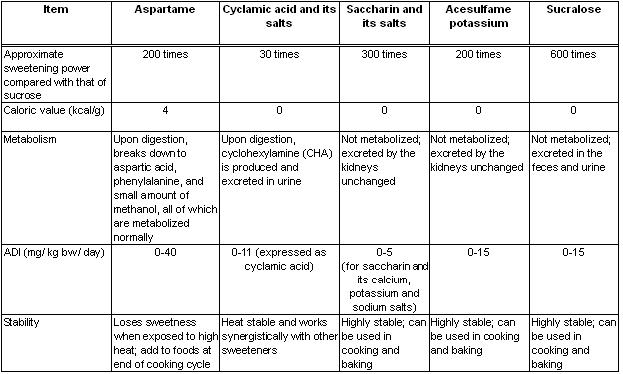
9. Nowadays, a wide range of artificial sweeteners is available for the food industry. Examples of some popular artificial sweeteners include aspartame, acesulfame potassium and saccharin. General information on some artificial sweeteners is described in Annex I.
SCOPE OF STUDY
10. This study focused on the exposures to artificial sweeteners from beverages as they are recognized as the main dietary source of artificial sweeteners. For the purpose of this study, beverages means any pre-packed non-alcoholic ready-to-drink drinks which include carbonated drinks, flavoured bottled water, sports drinks, herbal drinks, dairy-based drinks, soy-based drinks, juice drinks, tea and coffee.
11. Secondary school students were chosen as the population of this study because they are generally recognized as the population group which is more likely to have above average consumption of foods containing artificial sweeteners, such as soft drinks, candies and chewing gums.
12. According to the Food Adulteration (Artificial Sweeteners) Regulations of the laws in Hong Kong, six groups of artificial sweeteners are permitted for use in food in Hong Kong. They are (i) acesulfame potassium, (ii) aspartame, (iii) cyclamic acid and its sodium and calcium salts, (iv) saccharin and its sodium and calcium salts, (v) sucralose and (vi) thaumatin.
13. The term "artificial sweeteners" employed in this study includes both synthetic compounds and naturally occurring sweetening agents. This is in line with the existing legislation. As stipulated in the Regulations, artificial sweetener means "any chemical compound which is sweet to the taste, but does not include any sugars or other carbohydrates or polyhydric alcohols".
14. Among the six groups of artificial sweeteners listed above, all except thaumatin were included in this study. Thaumatin was not included in this study because, according to the JECFA's evaluation8 , thaumatin is a protein that is readily digested to food component. The dietary effect of thaumatin is only to make an insignificant contribution to the normal protein intake. JECFA allocated an ADI of "Not Specified" to thaumatin meaning that it is of very low toxicity which, on the basis of the available data, the total dietary intake of the substance arising from its use at the levels necessary to achieve the desired effect and from its acceptable background in food does not represent a hazard to health.
METHODOLOGY
Consumption Data
15. The consumption patterns of beverages of secondary school students were derived from the Food Consumption Survey conducted on local secondary school students in 2000 by FEHD. In the survey, a stratified three-stage sampling plan was used, with a sampling frame of 472 secondary schools and more than 380,000 students, covering almost all the local secondary schools. A total of 967 students from 27 schools participated in the survey yielding a response rate of 77% at the school level and 96% at the student level. The mean weight of the participated students was 52.0 kg. 9
16. The Food Consumption Survey covered both "diet" and "non-diet" beverages. In this study, except the two items which were known not to contain artificial sweeteners, i.e. drinking water and (non-diet) soda drinks, consumption data on all other beverages covered in the Survey were included. Apart from "diet soda drinks", the Food Consumption Survey does not provide information on the proportion of these beverages being sweetened by artificial sweeteners. Thus, to err on the conservative side, all these beverages were assumed to contain artificial sweeteners. These beverages were categorized into three groups, namely (i) carbonated drinks, (ii) flavoured bottled water and (iii) other beverages included in this study.
Sampling Plan
17. A market survey was conducted in the major local supermarkets to obtain a list of beverages containing artificial sweeteners that are available for sale in Hong Kong. In the market survey, all food items meeting our definition of beverage as stated in paragraph 10 were checked against the labels to see whether they contain artificial sweeteners. As a result, a total of 62 beverages were found to contain artificial sweeteners and all were taken for analyses.
18. These samples were categorized into those three groups according to the method of categorization as listed in paragraph 16. Samples of tea, coffee, soy-based drinks, juice drinks, dairy-based drinks, sports drinks and herbal drinks were put together under the group "other beverages".
Laboratory Analysis
19. Samples were then sent to the Food Research Laboratory (FRL) of FEHD for analyses. The levels of studied artificial sweeteners in each sample were analysed quantitatively by High Performance Liquid Chromatography (HPLC).
20. The limit of quantification for this study was 4 mg/L for each studied artificial sweetener in the samples. Artificial sweeteners are food additives and are not expected to be present in food unless they are added intentionally. The level necessary to achieve the desired effect should be higher than the limit of quantification (i.e. 4 mg/L). Therefore, samples with levels below the limit of quantification were assigned zero for enumeration purpose.
Dietary Exposures to Artificial Sweeteners from Beverages
21. By using the consumption data and the concentrations of artificial sweeteners in the samples, exposures to artificial sweeteners from beverages were estimated according to the following formula. 10

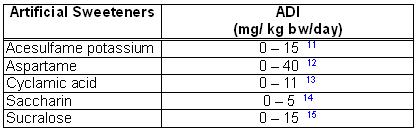
22. The exposure estimates were then compared with the respective ADIs established by JECFA for these artificial sweeteners (Table 1).
Table 1: Acceptable Daily Intake (ADI) of the Artificial Sweeteners Established by JECFA
RESULTS
Beverage Consumption Data
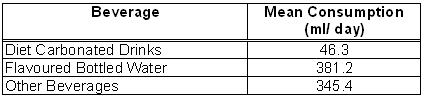
23. The average levels of consumption of beverages for secondary school students for the three groups were shown in Table 2.
Table 2: Average Consumption of Beverages for Secondary School Students who Consumed the Beverages
Concentration of Artificial Sweeteners in Beverages
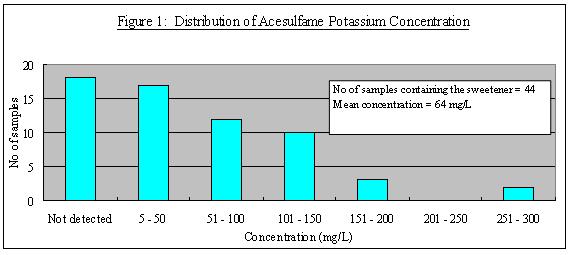
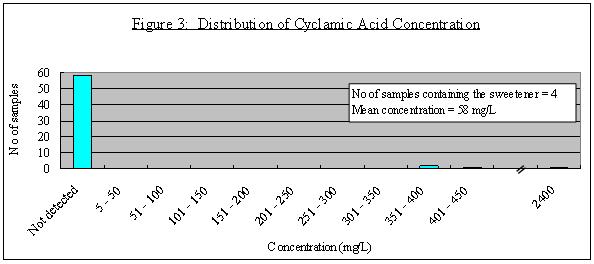
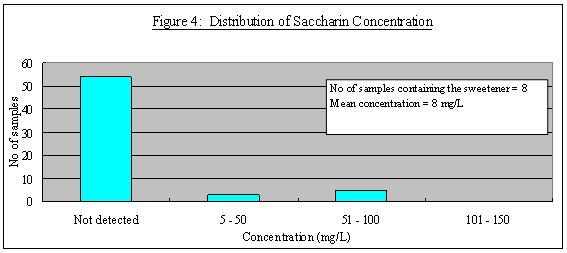
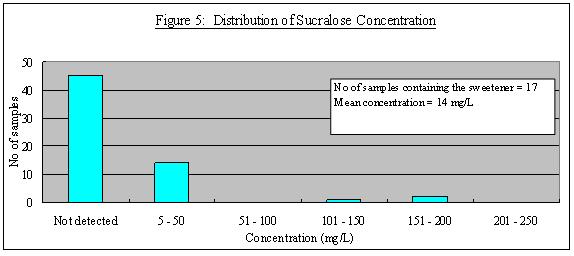
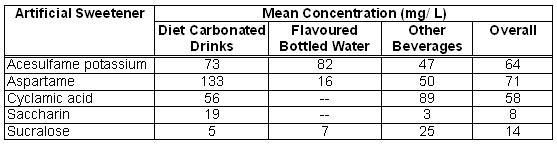
24. A total of 62 beverage samples were analyzed. The number of samples in each beverage group is given in Table 3. All the 62 samples contained one or more artificial sweeteners. The number of samples containing the studied artificial sweeteners and the minimum and maximum concentrations of the artificial sweeteners among those samples containing the respective artificial sweeteners are summarized in Tables 4 and 5 respectively. The mean concentrations of the artificial sweeteners for each beverage group are given in Table 6. Distributions of the level of artificial sweeteners in the samples are provided in Annex II.
Table 3: Number of Samples Taken for Analysis

Table 4: Number of Samples Containing the Studied Artificial Sweeteners
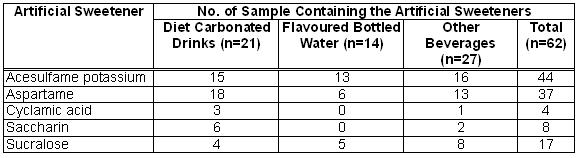
Table 5: Minimum and Maximum Concentration of the Artificial Sweeteners among those Samples Containing the Respective Artificial Sweeteners
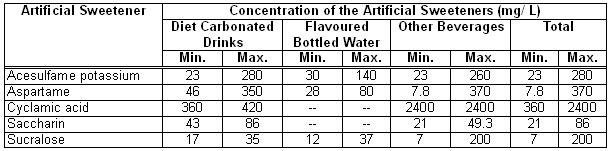
Table 6: Mean Concentrations of Artificial Sweeteners in Beverages
Dietary Exposures to Artificial Sweeteners from Beverages
Average Consumers
25. By combining the consumption data listed in Table 2 and the mean concentrations of artificial sweeteners in beverages listed in Table 6, the exposures to the studied artificial sweeteners of an average consumer were calculated and were then compared with the respective ADIs. The results are shown in Table 7.
Table 7: Dietary Exposures to Artificial Sweeteners from Beverages for an Average Consumer in Secondary School Students

High Consumers
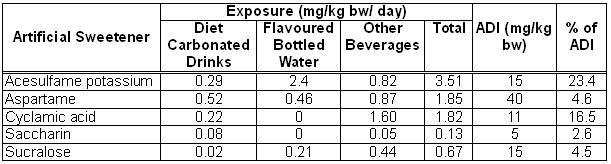
26. A further analysis was undertaken to estimate the risk that high consumers might be exposed to. In this study, the 95th percentile of the exposure levels to artificial sweeteners was used to represent the exposures for high consumers. The results are shown in Table 8.
Table 8: Dietary Exposure to Artificial Sweeteners from Beverages for High Consumers in Secondary School Students
DISCUSSION
Dietary Exposures to Artificial Sweeteners from Beverages
27. For an average consumer in secondary school students, daily exposures to the studied artificial sweeteners from beverages were 0.98 mg/kg bw for acesulfame potassium, 0.57 mg/kg bw for aspartame, 0.64 mg/kg bw for cyclamic acid, 0.04 mg/kg bw for saccharin and 0.22 mg/kg bw for sucralose. The percentages of the respective ADIs contributed by these exposures were 6.5% for acesulfame potassium, 1.4% for aspartame, 5.8% for cyclamic acid, 0.8% for saccharin and 1.5% for sucralose. The exposures were well below the respective ADIs established by JECFA for all five artificial sweeteners.
28. For high consumers, the daily exposures to the studied artificial sweeteners were 3.51 mg/kg bw (23.4% of ADI) for acesulfame potassium, 1.85 mg/kg bw (4.6% of ADI) for aspartame, 1.82 mg/kg bw (16.5% of ADI) for cyclamic acid, 0.13 mg/kg bw (2.6% of ADI) for saccharin and 0.67 mg/kg bw (4.5% of ADI) for sucralose. Exposures to the five artificial sweeteners for high consumers were also below the respective ADIs.
29. Therefore, it could be concluded that exposures to the studied artificial sweeteners, acesulfame potassium, aspartame, cyclamic acid, saccharin and sucralose, from beverages do not pose a risk to secondary school student's health for both average and high consumers.
Artificial Sweeteners Concentration in Beverages
30. Beverages were chosen in the estimation of exposures to artificial sweeteners in this study because they have been recognized as the major source of artificial sweeteners in the diet. 1617 Besides, some market surveys also reported that the soft drink industry has been identified as the biggest user of artificial sweeteners worldwide. 18
31. From the results, we found that, of the 62 beverage samples, acesulfame potassium was found in 44 samples (71%), aspartame was found in 37 (60%), sucralose was found in 17 (27%) and saccharin were found in 8 samples (13%). Cyclamic acid was a less commonly used artificial sweetener in beverages, which was only found in 4 samples (6%).
32. The results also showed that 43 out of 62 samples (70%) contained more than one artificial sweetener. Sweetener blends have become more popular in the production of foods and beverages, making use of the benefits of multiple sweeteners, as synergistic taste enhancement and sweetness profile modifications offer advantages over the use of single sweeteners. 19
33. From a food safety point of view, this practice allows sweeteners to be present at lower levels, and thus, consumption of single sweetener can be lowered.19
Exposures to Artificial Sweeteners from Sources Other Than Beverages
34. Although beverages are recognized as the major source of artificial sweeteners in the diet, exposures to artificial sweeteners may also result from other dietary sources such as table-top sweeteners, candies and chewing gums. A study conducted in Italy on the exposures to four artificial sweeteners from various sources including beverages, chewing gum, candies, table-top sweeteners, jam and yoghurt in teenagers showed that beverages were the main source of both cyclamate (85%) and acesulfame potassium (75%), but only represented 25% of aspartame intake and 4% of saccharin intake.16
35. We applied the Italian data to our study results to have a crude estimation of the dietary exposures to artificial sweeteners from dietary sources other than beverages. Adding these estimates to our results, the percentage ADI of exposures to the four artificial sweeteners from beverages and other dietary sources ranged from 6% for aspartame to 20% for saccharin for average consumers, and ranged from 19% for both aspartame and cyclamic acid to 65% for saccharin for high consumers. The estimated exposures for both average and high consumers were still below the ADIs.
Limitation
36. Food consumption data of beverages containing artificial sweeteners used in this study were derived from the Food Consumption Survey. However, only one item, soda drinks (diet), was indicated to contain artificial sweeteners in the Survey. Except drinking water and "ordinary" soda which do not contain artificial sweeteners, it was assumed in the study that all other beverages consumed by secondary school students were sweetened by artificial sweeteners. This is a conservative approach and would overestimate the actual exposure to artificial sweeteners.
37. Due to the lack of the consumption data of each beverage containing artificial sweetener by each person, exposures from beverages for those who exhibit "brand loyalty" cannot be estimated.
38. Only beverage was included in this study but exposure to artificial sweeteners from other dietary sources was possible. However, the estimated exposures from beverages together with other dietary sources as mentioned in paragraph 35 were still below the ADIs.
CONCLUSION AND RECOMMENDATIONS
39. The estimated exposures from beverages to the studied artificial sweeteners for an average consumer in secondary school students were 0.98 mg/kg bw for acesulfame potassium, 0.57 mg/kg bw for aspartame, 0.64 mg/kg bw for cyclamic acid, 0.04 mg/kg bw for saccharin and 0.22 mg/kg bw for sucralose. They were all well within their respective ADIs established by JECFA, ranging from 0.8% of the ADI for saccharin to 6.5% of the ADI for acesulfame potassium.
40. As for high consumers, the exposures to the studied artificial sweeteners were also below the ADIs, ranging from 2.6% of the ADI for saccharin to 23.4% of the ADI for acesulfame potassium.
41. It can be concluded that exposures to the five artificial sweeteners, acesulfame potassium, aspartame, cyclamic acid, saccharin and sucralose, from beverages do not pose a risk to the health of secondary school students for both average and high consumers.
42. Some advices are given to the trade and the consumers over the use of artificial sweeteners:
Advice to Trade
(a) Food manufacturers should only use the permitted artificial sweeteners stipulated in the Food Adulteration (Artificial Sweeteners) Regulations (Cap. 132 Sub. Leg. U) in accordance with Good Manufacturing Practices;
(b) To reduce the amount of exposure to each sweetener by consumers, using of more than one sweetener in a product can be considered;
(c) Artificial sweeteners should be properly labelled either by their specific names or the category on the packages according to the Food and Drugs (Composition and Labelling) Regulations.
Advice to Consumers
(a) A balanced diet is recommended to avoid excessive intake of any artificial sweeteners from a small range of food items;
(b) Persons who have concerns and medical reasons about the use of products containing artificial sweeteners should seek advice from health professionals.
REFERENCES
- Macrae R, Robinson RK, Sadler MJ, editors. Encyclopedia of Food Science, Food Technology and Nutrition. Vol. 7. London: Academic Press; 1993. p. 4476-9.
- Taylor RB. Ingredients. In: Ashurst PR, editor. The Chemistry and Technology of Soft Drinks and Fruit Juices. England: Sheffield Academic Press; 1998. p.16-54.
- International Food Information Council Foundation. Low-Calorie Sweeteners and Health. IFIC Review 2000 Oct; 1-12.
- International Food Information Council Foundation. More Choices for the Sweet Life. Food Insight Newsletter 2002 Sep-Oct; 2-3.
- Tompsett A. Product formulation. In: Ashurst PR, editor. The Chemistry and Technology of Soft Drinks and Fruit Juices. England: Sheffield Academic Press; 1998. p.55-83.
- World Health Organization (WHO). Principles for the Safety Assessment of Food Additives and Contaminants in Food. Environmental Health Criteria 70. Geneva: WHO; 1987. Available from: http://www.inchem.org/documents/ehc/ehc/ehc70.htm
- Nabors LO. Alternative Sweeteners: An Overview. In: Nabors LO, editor. Alternative Sweeteners. 3 rd ed. New York: Marcel Dekker, Inc.; 2001. p. 1-12.
- World Health Organization (WHO). Thaumatin. Food Additive Series 20: 605. Geneva: WHO; 1985. Available from: http://www.inchem.org/documents/jecfa/jecmono/v20je15.htm
- Food and Environmental Hygiene Department (FEHD). Food Consumption Survey 2000. Hong Kong: FEHD; 2001.
- World Health Organization (WHO). Report of a FAO/WHO Consultation - Food Consumption and Exposure Assessment of Chemicals. Geneva: WHO; 1997. p.10.
- World Health Organization. Acesulfame Potassium. Food Additive Series 28: 720. Geneva: WHO; 1990. Available from: http://www.inchem.org/documents/jecfa/jecmono/v28je13.htm
- World Health Organization. Aspartame. Food Additive Series 16: 497. Geneva: WHO; 1981. Available from: http://www.inchem.org/documents/jecfa/jecmono/v16je03.htm
- World Health Organization. Cyclamates, calcium, sodium and cyclohexylamine. Food Additive Series 17: 528. Geneva: WHO; 1982. Available from: http://www.inchem.org/documents/jecfa/jecmono/v17je08.htm
- World Health Organization. Saccharin and its salts. Food Additive Series 32: 791. Geneva: WHO; 1993. Available from: http://www.inchem.org/documents/jecfa/jecmono/v32je09.htm
- World Health Organization. Trichlorogalactosucrose. Food Additive Series 28: 721. Geneva: WHO; 1993. Available from: http://www.inchem.org/documents/jecfa/jecmono/v28je14.htm
- Leclercq C, Berardi D, Sorbillo MR, Lambe J. Intake of saccharin, aspartame, acesulfame K and cyclamate in Italian teenagers: present levels and projections. Food Additives and Contaminants 1999; 16(3): 99-109.
- Ilbäck NG, Alzin M, Jahrl S, Enghardt-Barbieri H, Bust L. Estimated Intake of the artificial sweeteners acesulfame K, aspartame, cyclamate and saccharin in a group of Swedish diabetics. Food Additives and Contaminants 2003; 20(2): 99-114.
- Gordon I R. Cultural and legislative influences on the consumption of high intensity sweeteners in Europe. In: Grenby TH, editor. Advances in Sweeteners. London: Blackie Academic and Professional; 1996. p.273-84.
- Von Rymon Lipinski. The blending of sweeteners - Applications and safety issues. In: Grenby TH, editor. Advances in Sweeteners. London: Blackie Academic and Professional; 1996. p.263-72.
ANNEX I - Summary Information on Artificial Sweeteners
ANNEX II - Distributions of Artificial Sweeteners in Beverages