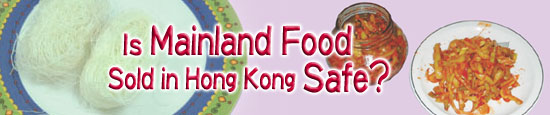
Rapid economic growth in Mainland China has brought with it ever improving living standards to the population. As far as nutrition and diet are concerned, they are no longer a simple matter of keeping the population from hunger. The general public now demand better food and safer food. In recent months, a spate of food safety and quality incidents, including poor quality milk powder and vermicelli as well as pickles preserved by industrial salt, was unveiled by the Mainland media. Some people opined that the safety standards of Mainland food have declined. For some Hong Kong citizens, they will turn their back whenever Mainland food is being mentioned. Well, is Mainland food sold in Hong Kong still safe for consumption?
Is Safety Level of Food on the Decline?
The Mainland food industry prospered ever since the Chinese government adopted the reform and open policies. In parallel, both the Government and the public have raised their expectations on food quality. In recent years, with an aim to further enhance food safety standards, the Mainland health authorities have stepped up surveillance of food products, cracked down fake food products and announced their food surveillance results on a regular basis in a bid to improve transparency of food safety issues. On the other hand, the China Central Television (CCTV) took up a detective role in filing sensational reports on various food safety incidents. The Mainland reports are extensively reproduced by the local media, creating an atmosphere, at least to some members of the public, that the safety level of Mainland food is in decline.
Is Food Sold in Hong Kong Safe?
Before answering this question, we should first look into the food safety control system of Hong Kong. With few major local food producers, our food supply relies mainly on import. The Mainland takes the lion's share, particularly in the categories of fresh provisions and non-staple food. All food sold in Hong Kong must meet the statutory safety requirements laid down under the laws of Hong Kong. High-risk food such as meat and milk must go through the import control system of the Food and Environmental Hygiene Department (FEHD). FEHD has put in place a food surveillance programme, under which the foods are checked at various levels including import, wholesale and retail to ensure that they are safe and hygienic. Follow-up action will be taken once food with questionable quality is detected. Offenders will be prosecuted and are liable to imprisonment for 6 months and a fine of $50,000.
The Mainland health authorities attach great importance to food for export purpose. They have all along imposed stringent control on food export to Hong Kong. Under the mutual notification system established between the General Administration of Quality Supervision, Inspection and Quarantine of China and FEHD, the Mainland authorities will inform Hong Kong whenever foods not meeting safety standards have entered the territory. Figures for the past three years showed that among the some 50 000 food samples tested in Hong Kong each year, the failure rates ranged from 0.3% to 0.5%, which reflected that Hong Kong's food safety level remained high.
Food Safety is everyone's business
The tripartite efforts of the Government, the trade and consumers are essential in upholding the high standards of food safety.
The Government's role is to maintain an effective surveillance and control system in Hong Kong and exercise the legal power conferred under the laws of Hong Kong to ensure that all food for sale in Hong Kong are safe for human consumption. Also under the Government's ambit is public education which aims to empower the public to become discerning customers, able to make smart food choices and handle food properly so that food risks can be reduced.
The trade's role is to provide safe and quality food products in compliance with the food laws of Hong Kong. Importers have to understand fully the statutory requirements of Hong Kong and not to sell substandard food.
As smart consumers, the public should take corresponding actions. They should buy food from reputable food traders. If they have doubts on the safety of a certain food, they should not buy it and report to FEHD.
Having a better understanding of the local food surveillance and control system, I hope you will not be unduly concerned when coming across media reports on Mainland food safety incidents in the future. We believe that with the joint efforts of the Government, the trade and consumers we can all enjoy food of high safety standards in Hong Kong.
For more information on production enterprise of export food in Mainland, please visit the following website: Certification accreditation administration of the People's Republic of China ( List of Production Enterprise of Export Food) (Chinese version only).