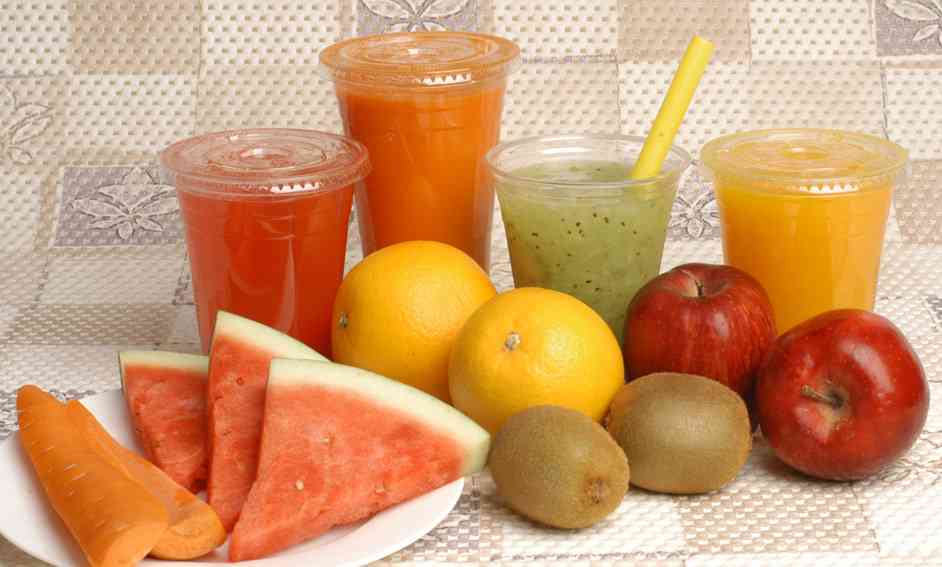
 In this Guideline, fresh fruit and vegetable juices refer only to those that are extracted from fresh fruits and vegetables (such as oranges, apples, carrots and celery), and are prepared and sold in the same business premises without undergoing any pasteurisation process. As harmful bacteria may present in fruits and vegetables while toxins such as patulin may be found in mouldy fruits and vegetables, improper handling may lead to food poisoning,
To ensure food safety, food handlers should be alert to possible food safety problems when preparing the juices and take appropriate preventive measures in their production.
Purchase and receiving
Problems: Presence of harmful bacteria, mould, chemicals and foreign materials.
Control:
- Purchase raw materials from reputable and reliable source.
- Use non-toxic and appropriate disposable cups.
- Inspect deliveries on arrival to ensure that
- the fruits and vegetables are fresh and suitable for preparing juices.
- there are no signs of contamination/damage to the fruits and vegetables.
- chilled items are delivered at 4°C or below and are free from observable temperature abuse.
- the packaging of disposable cups and straws are intact.
Storage
Problems: Cross-contamination and growth of harmful bacteria and mould.
Control:
- Handle all fruits and vegetables as gently as possible to minimise physical damage.
- Store deliveries immediately. Store chilled items at 4°C or below.
- Practise first-in-first-out principle for the stock.
- Store and handle the disposable cups and straws in a clean and sanitary manner.
Preparation
Problems: Cross-contamination and growth of harmful bacteria and mould
Control:
- Sort all fruits and vegetables carefully to remove mouldy fruits and vegetables.
- Wash all fruits and vegetables thoroughly and pay attention to the followings:-
- wash them in a sink exclusive for this use as far as possible.
- replace water regularly to prevent accumulation of microbes.
- if disinfectants are used, choose appropriate disinfectants and follow manufacturers' instructions (e.g. methods, quantities specified, etc.).
- Check the presence of internal mould when cutting the fruits and vegetables and discard the mouldy ones.
- Store all fruits and vegetables at 4°C or below once cut.
- Clean and sanitise all utensils and equipment including electric blenders and cutlery thoroughly at least once daily, and clean electric blenders and cutlery regularly (e.g. at four hours interval).
- Maintain good personal hygiene (e.g. wash hands frequently, wear clean protective clothing, etc.) at all times.
Sales
Problems: Cross-contamination and growth of harmful bacteria and mould
Control:
- Deploy separate staff to handle cash and prepare fresh juices.
- Keep all fresh juices, if not sold immediately after preparation, in a container with close-fitting covers or stoppers. Keep them separately from other commodities in a refrigerator at 4°C or below.
- Avoid holding cut fruits or vegetables and fresh juices at above 4°C for more than two hours.
- Avoid prolonged storage which affects the quality and safety of the juices. Distribute and sell finished products in a first-in-first-out basis and discard them at the end of the day.
- Keep the disposable cups and straws in dust-proof containers.
Management system
Implement a preventive food safety management system (such as the HACCP-based Food Safety Plan) to identify and control food safety problems at critical manufacturing process.
Enquiry
For related information, please contact the Communication Resource Unit.
Tel. : 2381 6096
Address : Room 401, 4/F, Food and Environmental Hygiene Department Nam Cheong Offices and Vehicle Depot, 87 Yen Chow Street West, Kowloon